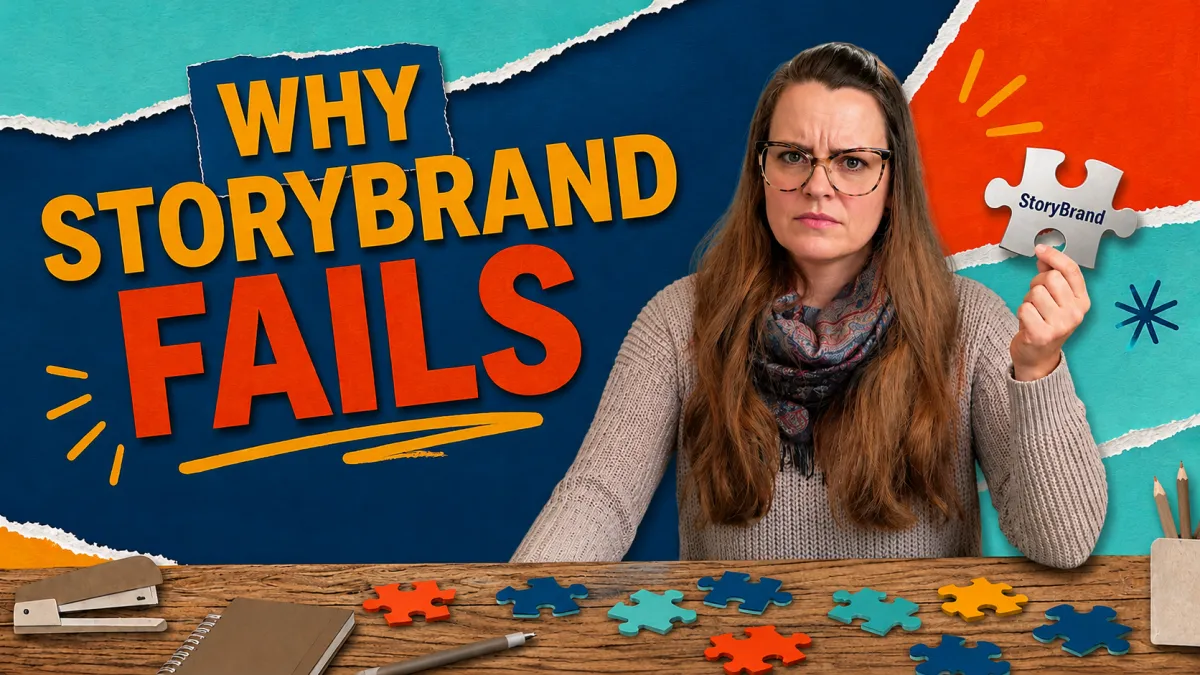
I'm StoryBrand Certified. Here's Why StoryBrand Alone Won't Fix Your Client Problem
By Vicky Sidler | Published 15 July 2026 at 12:00 GMT+2
You are an incredibly capable consultant. Your services are excellent, your positioning looks fantastic on paper, and your past clients love you.
But when you open your inbox, it tells a deeply tragic story. It is utterly stuffed with early-stage bargain hunters, people demanding a 50% discount, and folks who just want to "pick your brain" over a quick, unpaid coffee. You’ve probably been told by some internet guru that this is just a numbers game, or that you simply have a leaky sales pipeline.
Well, actually, that is a complete myth.
The uncomfortable truth is that your positioning is completely fine, but your messaging is quietly rolling out the red carpet for the exact wrong people. Let’s debunk the massive industry lie that picking a niche is the same thing as writing your copy, and fix the actual problem before you set another advertising dollar on fire.
TL;DR:
Positioning is the strategic choice of who you serve; messaging is the practical expression of that choice. If you confuse the two, you will inevitably attract terrible clients.
While frameworks like StoryBrand are incredibly powerful, they are not a magical silver bullet. Messaging amplifies your existing business model, but it cannot fix a fundamentally broken offer or a poorly defined audience.
You must aggressively filter your leads by clarifying exactly who you are for, naming their problem in their own words, and laying out a concrete, three-step plan to solve it—a task that generative AI simply cannot do for you.
👉 If your marketing feels like a second, unpaid job that yields uncertain results, your foundation is completely broken. You need diagnostic clarity. Take The Failure-Proof Marketing Test to answer a few questions and see whether your marketing is focused on the vital 20% or buried in low-impact activity.
Table of Contents:
I'm StoryBrand Certified. Here's Why StoryBrand Alone Won't Fix Your Client Problem
What Exactly Are The Symptoms Of A Misaligned Message?
Why Do We Keep Confusing Positioning With Messaging?
But Isn't A Proven Framework Like StoryBrand All You Need?
How Do You Actually Filter For The Right People (And Why AI Cannot Do It)?
What Happens When You Skip The Messaging Audit Entirely?
1. Why Your Marketing Feels Broken (And The 5-Step System To Fix It)
2. The 3 Signs Your DIY Marketing Phase Is Officially Over
3. Marketing Made Simple by Donald Miller: Summary For Small Businesses
4. Marketing Hourglass Explained: A Smarter Way to Grow Your Small Business
5. The 1-Page Marketing Plan by Allan Dib Summary
1. What is the difference between positioning and messaging?
2. Why shouldn't I use AI to write all of my website copy?
3. How do I make my messaging filter out the wrong clients?
4. Will the StoryBrand framework fix my broken sales pipeline?
What Exactly Are The Symptoms Of A Misaligned Message?
The marketing industry absolutely loves to convince you that if you just buy a more expensive CRM software, your bad leads will magically disappear.
But throwing expensive tech at a fundamentally broken message is like putting a band-aid on a broken leg. The leads showing up in your calendar are not a random, unfortunate accident; they are the exact, logical result of what your words explicitly promised them!
Take one of my recent clients—a brilliant strategic consultant whose website was so aggressively generic, it could have been legally trademarked by literally any consultant in town. Because her homepage spoke in completely vague abstractions, absolutely everyone on planet Earth thought it was meant for them. Her calendar instantly filled up with people outside her niche, people utterly confused about what she actually did, and people whose opening gambit was to haggle her prices down.
Why? Because her message never anchored the exact problem or the stakes, so they just defaulted to comparing her on price like she was a used car. Her calendar filled up, but her revenue didn't. Understand this clearly: none of this was happening because her service was weak—it was happening because of a massive, industry-wide misunderstanding about how words actually work.
Why Do We Keep Confusing Positioning With Messaging?
There is a quiet, devastating assumption that breaks almost every marketing effort: most founders believe that once they finally pick a niche, their messaging is basically done. This is absolutely false.
Positioning is the strategic decision of who you serve and what problem you solve. But messaging is the actual, concrete words on your website that make that decision recognizable to the right person.
Positioning: Chooses the destination (your niche, problem, and differentiation).
Messaging: Acts as the map. If you fuzz the map, your channels amplify the wrong signal!
Channels: The vehicle that distributes that message (website, email, social, ads).
Let me give you a real example from one of my clients who owns a luxury vacation villa. It was a premium offer with premium positioning, yet the copy on his website didn’t differentiate his property from any of the other available options. It just listed generic features with zero words that would resonate with his ideal audience.
We completely rewrote his page using human-crafted, StoryBrand-style messaging. Within a month, he was waking up to qualified inquiries every single morning—meaning he actually reduced his ad spend because he didn't need to pay for cheap volume anymore. Better words, fewer ads, more right-fit buyers.
Before moving on:
If you want to know specifically where your current system is weakest, take The Failure-Proof Marketing Test—it's a short, free diagnostic. Answer a few questions, and it shows you the weak points most likely to be stalling your growth right now.
But Isn't A Proven Framework Like StoryBrand All You Need?
I need to confess something that nobody in the messaging world wants to admit out loud.
The single most dangerous thing about a powerful framework is that it tricks you into feeling like you've solved the whole problem when you've really only solved a tiny fraction of it. I am a certified StoryBrand Guide who uses this framework every single week, but I need to be brutally honest with you: StoryBrand is incredibly powerful, but it is not the entire system!
The book makes it feel like "fix the words and they will come." If the rest of your business is perfectly healthy, that might be true. But if your core offer is messy or your platforms are wrong, the most structurally perfect StoryBrand message in the universe will not save you. Messaging simply amplifies what is already there; it cannot magically fix a broken business model.
Think of it like putting premium racing fuel into a car with a shattered transmission. The fuel is amazing, but you still aren't going anywhere! Marketing works the exact same way, because beautiful messaging layered on top of a misaligned offer is just a much more expensive version of the exact same problem. Messaging has to sit inside a larger system, because it cannot survive on an island by itself. StoryBrand belongs inside a comprehensive Failure-Proof Marketing System, not as a standalone magic trick.
How Do You Actually Filter For The Right People (And Why AI Cannot Do It)?
Most marketing gurus just tell you to "be clearer"—which is the exact equivalent of a doctor telling you to "be healthier." It is technically true, but completely useless advice! To actually filter your leads, you need three very specific fixes.
Fix number one: Be violently clear about who it's for by moving away from broad, lazy categories. Saying you help "small business owners" is like a doctor saying they treat "mammals." It is technically true, but if my arm is broken, I am not going to the guy who just finished operating on a hamster! Rather say "service-based founders stuck at a revenue plateau," because if a total stranger can't immediately know if your service is for them, your words are failing you.
Fix number two: Name the problem in your client's actual language. Stop using lazy corporate jargon like "synergistic operational workflows." No one wakes up in a cold sweat at 3 AM worrying about their workflows! Use the exact words your clients use when they come to you, like "marketing is taking up too much of my time" or "I am struggling to get leads." Ground your message in the exact moment they realize they need help.
Fix number three: Give them a clear outcome and a plan instead of promising vague nonsense like "you'll feel confident." If I just tell you "I'll handle your SEO," you might panic because it sounds like a black hole for your money. But if I show you my exact Failure-Proof Road Map—step one, we Book a Coffee Chat; step two, we Build Your Custom Strategy; and step three, you Enjoy Steady, Calm Growth—you immediately calm down!
When people see exactly where they are, where they are going, and how you will get them there, they stop asking "how much does this cost?" and start asking "when can we start?"
If you think you can just generate this empathy with an AI prompt, you are deeply mistaken. My team and I ran a head-to-head test building two StoryBrand-style landing pages—one written by me, and one cranked out by StoryBrand's own AI tool. The AI version looked structurally flawless, yet it produced absolutely zero conversions over the entire life of the test! The human-written version doubled the engagement and actually converted.
The data backs this up. A comparative performance study across 2,000 campaigns on LinkedIn found that human copy consistently produces higher engagement and better conversion rates because it actually captures emotional nuance. Another study by Theme Foliage comparing AI versus human landing page copy showed visitors spent more time on the human-written page and converted at a higher rate. Furthermore, a study by Bynder of 2,000 consumers found that over half become visibly less engaged when they suspect content is AI-generated, and a quarter explicitly said AI-sounding copy makes a brand feel lazy. The difference isn't the framework—it is the human language pulled from real sales calls, which you cannot get from an AI template. You only get it from actually listening to your clients.
What Happens When You Skip The Messaging Audit Entirely?
The single most expensive mistake you can make is building a gorgeous, five-figure website wrapped around fuzzy, meaningless words.
I want you to pull up your homepage right now and ask yourself these four diagnostic questions:
Can a specific person recognize themselves in your opening line, or is it written for "everyone"?
Is the main problem described in concrete terms, or is it just corporate jargon?
Is there a tangible outcome and a plan?
Would the wrong client feel comfortable contacting you, or would they automatically self-select out?
That last question is the one almost everyone skips, because good messaging doesn't just attract the right people—it actively, purposefully repels the wrong ones, and that is not an accident! That is the entire goal.
If your honest answer to any of those questions is "not really," you don't have a website problem; you have a messaging problem, and it is completely fixable before you spend another dollar. You need diagnostic clarity before you build anything else, which is exactly why you need to take The Failure-Proof Marketing Test right now.
👉 Stop attracting the wrong clients. Take the test today.
Related Articles:
1. Why Your Marketing Feels Broken (And The 5-Step System To Fix It)
If you know your messaging is a disaster but you have no idea how to actually build a machine to distribute it, this article breaks down the exact five-step client acquisition system you need to run to escape the feast-or-famine cycle for good.
2. The 3 Signs Your DIY Marketing Phase Is Officially Over
If you are currently treating your marketing like a panicked, late-night Uber Eats binge, this article perfectly diagnoses the exact moment when your "scrappy" DIY efforts cross the line into self-sabotage, helping you understand why your scattered tactics are draining your bank account.
3. Marketing Made Simple by Donald Miller: Summary For Small Businesses
This article provides the exact funnel framework you need to replace your current confusion. It delivers a concrete, repeatable path—from a clear one-liner to an automated email sequence—that ensures you are no longer relying on luck, but on a predictable, diagnostic path from curiosity to commitment.
4. Marketing Hourglass Explained: A Smarter Way to Grow Your Small Business
If you find yourself obsessing over top-of-funnel traffic while your actual conversion rates stay flat, this article is your reset button. It expands your perspective from "chasing eyes" to managing the full customer journey, ensuring you have the right touchpoints to turn strangers into repeat, high-value clients.
5. The 1-Page Marketing Plan by Allan Dib Summary
If you feel overwhelmed by a "second job" in marketing, you need structure. This summary offers a simple, 9-box roadmap that turns your chaotic to-do list into a clear, sequenced plan, pushing you toward measurable activity rather than just more busywork.
FAQs:
1. What is the difference between positioning and messaging?
Positioning is the internal strategic choice of who you serve, what problem you solve, and how you differentiate yourself in the market. Messaging is the external expression of that choice—the actual, tangible words on your website and in your emails that make your positioning recognizable to your ideal buyer.
2. Why shouldn't I use AI to write all of my website copy?
Studies show that human-written copy consistently outperforms AI-generated text in both engagement and conversion rates. AI lacks emotional nuance and relies on generic templates, which can make your brand sound impersonal and lazy. You need to use the actual language your customers use, which you only get by listening to them, not prompting a robot.
3. How do I make my messaging filter out the wrong clients?
To actively repel bad leads, you must move away from broad categories and name the specific problem you solve in concrete terms. If your website says "Helping businesses grow," anyone can assume you are for them. If it says "I build marketing systems for service-based founders stuck at a revenue plateau," the wrong people will immediately self-select out.
4. Will the StoryBrand framework fix my broken sales pipeline?
StoryBrand is an incredibly powerful messaging tool, but it is not a magic fix for a broken business. If your core offer is misaligned, your pricing is wrong, or you are targeting the wrong audience, clarifying your message will just amplify a bad strategy. Messaging must sit inside a holistic, Failure-Proof Marketing System.
5. What are the signs that my messaging is broken?
If your calendar is full of early-stage businesses, bargain hunters, and people who constantly ask "So what exactly do you do?" on discovery calls, your messaging is failing. A clear message anchors the stakes and the outcome, preventing leads from treating you like a commodity to be haggled with.