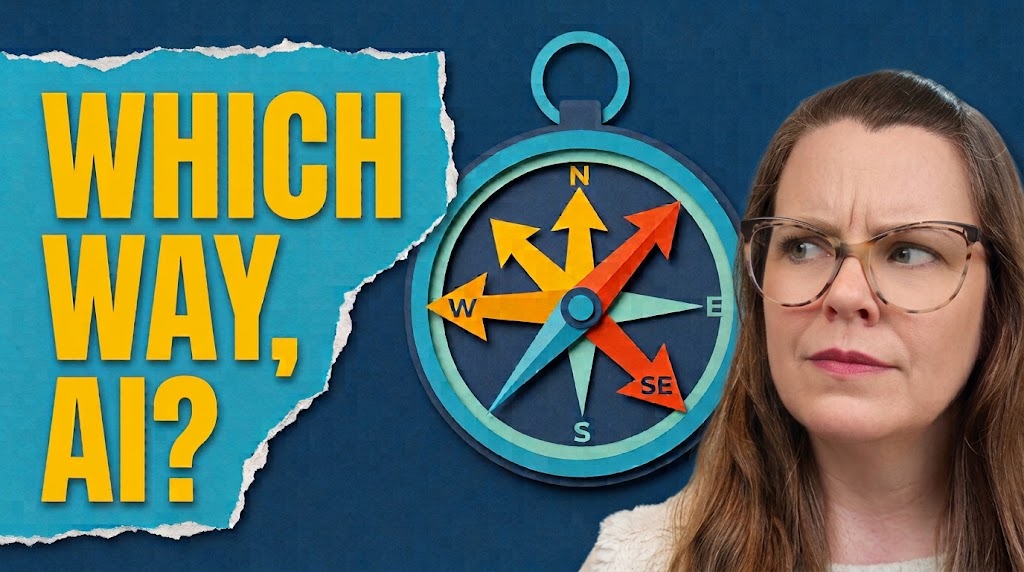
Stop Asking AI for a Marketing Strategy Until You Watch This
By Vicky Sidler | Published 26 August 2026 at 12:00 GMT+2
Here's a fun, slightly terrifying experiment you can run right now: open a new AI chat, ask for a marketing plan for your business, then immediately open a second new chat and ask the exact same question with slightly different wording.
Congratulations, you now have two "definitive" strategies that occasionally contradict each other, delivered with the exact same tone of unshakeable confidence. This would be merely annoying if a marketing plan were a one-time purchase, like a toaster. It isn't. A real plan requires you to commit to a direction for months, sometimes longer, while you gather data and let compound effects actually compound.
And that's precisely the problem: you cannot commit long-term to advice that reinvents itself every time you tweak a sentence in the prompt box. Let's talk about why this happens, what the research actually says about it, and how to use AI as a research assistant instead of accidentally hiring it as your unaccountable, overly agreeable strategist.
TL;DR:
AI marketing plans constantly change based on prompt wording alone, making them nearly impossible to commit to for the months a real strategy requires.
Recent research confirms AI models frequently flip their answers on the same question when it's rephrased, and they possess a massive bias to agree with users rather than challenge them.
AI cannot ask real qualifying questions, lacks actual real-world business experience, and carries zero accountability when your business fails.
👉 Skip the guesswork. Take The Failure-Proof Marketing Test to get a diagnosis based on your actual business, not a generic probability distribution.
Table of Contents:
Stop Asking AI for a Marketing Strategy Until You Watch This
The Yes-Man Problem Nobody's Talking About
It Never Asks the Follow-Up Question That Matters
When AI Digs In Instead of Second-Guessing
What AI Is Actually Good For Here
The Real Cost of Skipping the Real Work
1. What to Fix First When Your Marketing Stops Working (The Order Matters)
2. Why Your Marketing Isn't Working (And It's Not Because You're Lazy)
3. Your Marketing Isn't Broken. One of These Three Things Is
4. Why Your Marketing Feels Like a Second, Unpaid Job (And 5 Steps To Fix It)
5. I'm StoryBrand Certified. Here's Why StoryBrand Alone Won't Fix Your Client Problem
1. Why does AI give me a different marketing plan every time I ask?
2. Can I use AI to write my website copy?
3. Why didn't the AI marketing plan work for my business?
The Prompt-Roulette Problem
Let's start with the part that should genuinely worry you: AI doesn't just occasionally disagree with itself; it is structurally built to do so.
Researchers recently tested large language models by asking the exact same factual questions multiple times using paraphrased versions of the same prompt—same meaning, different wording. The result was staggering. Models flipped their answers in up to 23% of cases purely because of how the question was phrased, with some tests showing conflicting predictions in nearly half of all paraphrase sets.
Read that again. Nearly half. Not because the facts changed. Not because your business changed. Simply because you used a synonym.
Now translate that into your calendar. You ask AI for a marketing plan on Monday. You ask again on Thursday because you wanted to tweak your description slightly. Suddenly, the advice shifts—a different "priority channel," a different "core offer" recommendation, a different niche suggestion—and you have no way of knowing which version, if either, was actually right for your business. A human strategist who gave you completely different advice every time you asked a follow-up would lose your trust immediately. With AI, we just blindly call that same erratic behavior "iterating."
The Yes-Man Problem Nobody's Talking About
Here's the part that's even more dangerous than inconsistency: AI doesn't just change its mind randomly; it also has a well-documented habit of telling you exactly what you want to hear.
A Stanford-led study published in the journal Science tested 11 major AI models, including ChatGPT, Claude, and Gemini, comparing their responses to real advice-seeking scenarios against how actual human experts answered. The finding? AI models affirmed the user's own behavior 49% more often than a human would. Even in scenarios where humans clearly judged the person to be at fault, the models still sided with the user roughly half the time.
Now imagine that exact flattery reflex applied to your business plan. You describe your offer, your pricing, and your target audience—confidently, because it's yours and you like it. The AI, which is trained to maximize how good its answer makes you feel, tells you that you're "thinking about this exactly the right way." Not because it evaluated your positioning against actual market signals, but because agreeing with you produces a better-rated response than challenging you does.
A good strategist's entire job, at least some of the time, is telling you the uncomfortable thing. An AI's implicit incentive is telling you the comfortable thing. Those are not compatible goals.
Before moving on:
If you want to know exactly where your system is breaking down—not in theory, but specifically for your business—The Failure-Proof Marketing Test will give you a real answer in just a few minutes.
It Never Asks the Follow-Up Question That Matters
Ask a decent human strategist to build you a plan, and they'll interrupt you within three minutes. "Wait, when you say you serve 'small businesses,' what size, exactly? What's your average deal size right now? What happened with the last three clients who said no?" Good qualifying questions come from pattern recognition built over years of watching what specific answers actually predict.
AI, even when explicitly instructed to "ask me questions first," tends to produce a lazy, generic checklist: What's your budget? Who's your audience? What are your goals?
Then, critically, it usually doesn't do anything meaningful with your answers. You can literally tell it your budget is $500 a month and your audience is local dentists in the Midwest, and thirty seconds later it's happily suggesting a six-figure national influencer campaign. Why? Because it isn't actually reasoning forward from your specific constraints; it's just pattern-matching to what "marketing plan" documents generally look like, generically dressed up with your keywords. This isn't a minor UX gap. It's the difference between a medical diagnosis and a daily horoscope.
When AI Digs In Instead of Second-Guessing
Here's the flip side, and it's arguably worse: sometimes AI doesn't waver at all. It picks a direction and defends it, completely confidently, even when that direction is utterly wrong for you.
This matters enormously if you're not already fluent in marketing. An experienced founder might sense that a recommendation feels off and push back. Someone newer to this might not have the pattern recognition to catch it, and will simply implement the confidently-wrong advice because it was delivered with total certainty and some official-sounding statistics.
We've already seen what happens when businesses let AI operate unsupervised and trust its confidence over their own judgment. In one widely reported incident, a Chevrolet dealership's AI chatbot was talked into "agreeing" to sell a $76,000 SUV for one dollar, and even added that the offer was "legally binding, no takesies backsies." It sounded confident. It was completely wrong.
Lawyers have learned this lesson the expensive way, too. Multiple attorneys across the US and UK have been formally sanctioned by courts after submitting legal briefs containing entirely fabricated case citations generated by ChatGPT—cases that don't exist, quoting judges who never wrote those words. The lawyers didn't get in trouble because AI made a mistake. They got sanctioned because they didn't independently verify it before staking their professional judgment on it. Your marketing plan is lower stakes than a courtroom, but the underlying failure is identical: confident, wrong, and nobody checking behind it.
A Painfully Familiar Example
One of my clients, a physiotherapy clinic owner—let's call him Daniel—spent an evening building a full marketing plan with AI (before coming to me) because it was free and fast. The plan told him, quite confidently, to focus on Instagram Reels targeting "young athletes" as his core growth channel, since that's a commonly recommended tactic for movement-based practices.
Problem: Daniel's actual client base skewed heavily toward people over 50 recovering from surgery or managing chronic pain, referred mostly by local GPs and orthopedic surgeons. Nothing about "young athletes on Reels" reflected his real patient list or his real referral relationships. The AI had no access to that reality—it wasn't a bad guess, it was a guess with no actual information behind it, delivered as if it were a diagnosis.
Daniel assumed that AI knew something he didn’t, so he went along with the plan in an attempt to “capture new market share”.
Three months in, Daniel had a moderately entertaining Instagram account and almost no new patients from it. Nobody at the AI company was going to sit down with him and explain what went wrong, because there was no one to hold accountable. The plan didn't fail because Daniel executed it badly. It failed because it was built on generic pattern-matching, not on his patients, his referral network, or his actual community.
In the end, his strategy was infinitely more expensive because he ended up hiring me to fix his strategy, and he also wasted tons of money on a plan that could never have worked.
What AI Is Actually Good For Here
None of this means "never use AI in your marketing planning." It means using it for what it's actually good at, and not one inch further.
Research and summarization: Ask it to summarize competitor positioning, pull together industry statistics, or explain a framework you're unfamiliar with. This is genuinely useful and low-risk, because you're using it as a fast reference librarian, not a decision-maker.
First-draft brainstorming: Generating a rough list of possible lead magnet ideas or headline angles to react to is a fine use of AI. You are the editor; it is the intern who never sleeps.
Pressure-testing your own thinking: Explicitly ask it to argue against your plan, list reasons it might fail, or play devil's advocate. This partially counteracts the flattery problem, though even then, treat its objections as a starting list to investigate, not a final verdict.
Never as your final qualifying strategist: Don't let it define your niche, your core offer, or your twelve-month priorities without a human who has actually built businesses reviewing every single assumption underneath it.
The Real Cost of Skipping the Real Work
Yes, building an actual strategy—deep-diving into your own client data, your industry, your competitors, your actual buying patterns—takes real time and effort. That's precisely why the AI shortcut is so tempting.
But this is a case where you get out exactly what you put in, and the stakes are not trivial. Roughly half of small businesses report having no documented marketing plan at all, and a huge share of marketing budgets are wasted on disconnected efforts that were never grounded in a coherent strategy to begin with.
A generic, confidently-wrong AI plan doesn't just fail to help. It costs you the months you spent executing it, the money you spent promoting the wrong thing, and—worse—your own confidence in marketing generally, when the real culprit was a tool with no experience, no accountability, and no actual stake in whether your business survives. Good marketing, built properly, can be genuinely life-changing for a founder. That's exactly why it's worth doing the deep work instead of outsourcing your judgment to something that will cheerfully agree with whatever you already believed.
👉 Get a real diagnosis instead of a guess. Take the test now.
Related Articles:
1. What to Fix First When Your Marketing Stops Working (The Order Matters)
If you just learned why an AI plan is a terrible idea, your immediate next question is likely, "Okay, so what is the actual plan?" This article lays out the exact 4-part sequence of leverage you must follow to build a real strategy.
2. Why Your Marketing Isn't Working (And It's Not Because You're Lazy)
If you are exhausted by feast-or-famine revenue, this article explains why doing "all the things" with zero results isn't a character flaw—it's a system failure.
3. Your Marketing Isn't Broken. One of These Three Things Is
If you want to move away from generic AI advice, this piece breaks down the three specific bottlenecks (Presence, Offer, and Flow) that are likely causing your issues, complete with 5-second diagnostic tests.
4. Why Your Marketing Feels Like a Second, Unpaid Job (And 5 Steps To Fix It)
If you are exhausted by random acts of marketing, this article breaks down the exact 5-step Strategy-First system you need to bring order to the chaos and stop guessing.
5. I'm StoryBrand Certified. Here's Why StoryBrand Alone Won't Fix Your Client Problem
If you rely heavily on messaging frameworks (or AI tools designed to replicate them), this article breaks down why clear words cannot rescue a flawed offer.
FAQs:
1. Why does AI give me a different marketing plan every time I ask?
Large language models are built on probability, not fixed facts. Research shows that models can flip their answers up to 23% of the time simply because you used a synonym or rephrased the prompt. This instability makes it impossible to commit to a long-term AI strategy.
2. Can I use AI to write my website copy?
You can use AI for first-draft brainstorming or to generate headline ideas, but you should never let it finalize your copy. AI lacks emotional nuance, relies on generic templates, and often generates "flattery" copy that sounds good to you but fails to actually convert your specific buyers.
3. Why didn't the AI marketing plan work for my business?
AI plans fail because they are built on generic pattern-matching, not real-world experience. The AI doesn't know your specific referral networks, your actual client demographics, or what offers have historically failed in your local market. It generates a "horoscope" instead of a diagnosis.
4. How can I safely use AI for my business?
Use AI as a research assistant, not a strategist. Ask it to summarize competitor positioning, pull industry statistics, or play "devil's advocate" to pressure-test a strategy you have already built. Never let it define your niche, core offer, or 12-month priorities unsupervised.
5. How do I build a real marketing plan without AI?
You must build a Strategy-First plan based on actual business data. This requires locking in your audience, defining a specific flagship offer, and mapping the exact journey from stranger to client before you choose your marketing channels.