

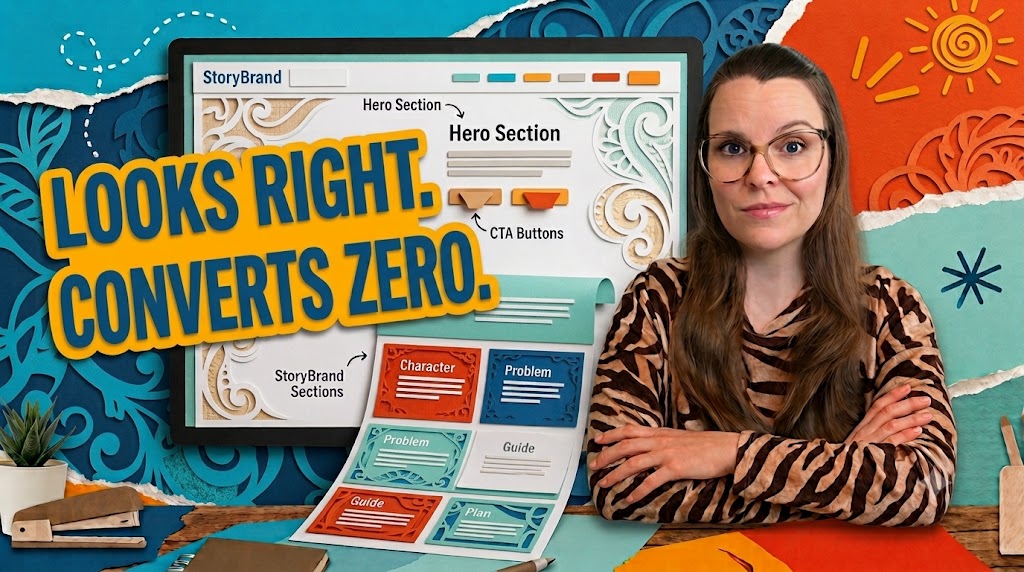
Why Your "Great Offer" Isn't Selling (Hint: It's Not Your Messaging)
By Vicky Sidler | Published 22 July 2026 at 12:00 GMT+2
So a thousand people visited your perfectly designed StoryBrand landing page this week, and absolutely zero of them decided you were actually worth talking to.
You’re not alone: U.S. data shows that around 50% of small businesses fail within five years and 66% within ten, with poor marketing, weak demand, and lack of a clear plan among the top reasons.
If you followed all the rules only to be met with the kind of deafening silence usually reserved for a terrible open-mic comedian, you need to stop what you are doing right now. Because tweaking your headlines is exactly like putting a fresh coat of paint on a condemned building—your words aren't the problem; your positioning is.
There is a very specific, tragic type of business owner who does everything the internet gurus tell them to do. They read the book, they build the funnel, they hire the copywriter, and they still get absolutely nothing. And the most uncomfortable part of that realization is that their execution was actually flawless.
Let's explore why perfect marketing on a mis-positioned offer is just a very expensive way to fail, and how to actually fix the structural problem destroying your sales.
TL;DR:
A perfectly polished StoryBrand page on a mis-positioned offer doesn't fail quietly; it fails efficiently, bringing the absolute wrong people into your funnel at a much higher cost.
Founders constantly blame their messaging because marketing dashboards show click-through rates, but there is no metric or pie chart that alerts you when your positioning is vague.
In one recent survey, only 20% of small business owners said their marketing was ‘very’ or ‘extremely’ effective, while four in five described it as barely working—despite pouring hours into tactics.
To make your offer the obvious choice, you must manipulate three specific levers: a hyper-specific niche, a polarizing point of view, and a laser-focused offer.
You must run the 10-Minute Hand-Raiser Test before spending another dollar on ads to prove your market actually wants what you are selling.
👉 If your marketing feels like a second, unpaid job that yields uncertain results, your foundation is completely broken. You need diagnostic clarity. Take The Failure-Proof Marketing Test to answer a few questions and see whether your marketing is focused on the vital 20% or buried in low-impact activity.
Table of Contents:
Why Your "Great Offer" Isn't Selling (Hint: It's Not Your Messaging)
The Wrong Diagnosis Is A Corporate Doom-Loop
Positioning, Stripped Of Every MBA Word That Makes Your Eyes Glaze Over
Why Do We Keep Blaming The Words For A Structural Problem?
Colgate Lasagna, Crystal Pepsi, And Other Hilarious Cautionary Tales
Three Levers That Change Who Thinks Your Offer Is Obviously Valuable
The Simple "Hand-Raiser" Test To Run Before Touching Your Headline
1. Why Your Marketing Feels Broken (And The 5-Step System To Fix It)
2. The 3 Signs Your DIY Marketing Phase Is Officially Over
3. I'm StoryBrand Certified. Here's Why StoryBrand Alone Won't Fix Your Client Problem
4. Marketing Made Simple by Donald Miller: Summary For Small Businesses
5. Marketing Hourglass Explained: A Smarter Way to Grow Your Small Business
1. Why isn't my perfectly designed StoryBrand landing page converting?
2. What exactly is the difference between positioning and messaging?
3. Why do founders constantly blame their copywriters when sales drop?
The Wrong Diagnosis Is A Corporate Doom-Loop
The StoryBrand framework is legitimately useful. The hero, the guide, the plan, the stakes—on paper, it is a masterpiece.
But the massive issue arises when founders apply a completely sound messaging framework to an offer that is playing the wrong role entirely. A perfectly polished StoryBrand page on a mis-positioned offer doesn't fail quietly; it fails efficiently. It just brings the absolute wrong people in faster, with terrifying precision, and at a much higher cost.
According to U.S. Bank data, 78% of small businesses fail because they lack a well‑developed business and marketing plan, not because they didn’t A/B test enough headlines.
The wrong diagnosis of "we just need better words" sends founders back into the exact same corporate doom-loop: fire the copywriter, buy another marketing course, change the button color from blue to slightly-darker-blue. But if the words were never the culprit, there is something upstream that actually is. And once you see it, you cannot unsee it.
Positioning, Stripped Of Every MBA Word That Makes Your Eyes Glaze Over
Here is what almost nobody tells you: positioning isn't a cute little brand exercise you do once on a whiteboard and then aggressively ignore for five years.
Positioning is a series of three very specific decisions—usually made completely by accident—that control whether your offer feels obvious or totally invisible to your ideal client.
First, what category are you in?
Calling yourself a "consultant" is like calling yourself a "carbon-based lifeform"—it is technically true, but absolutely nobody is typing that into Google when their business is on fire. Your category dictates the comparison set buyers use to judge you.
Second, who exactly is it for?
"Small businesses" is not a niche—it is literally half the global economy. That is exactly like a doctor saying their medical specialty is "things with blood." Specificity is what makes a buyer feel seen, and feeling seen is the only thing that creates buying urgency.
Finally, why should they choose you over doing it themselves, over hiring a generic agency, or over just watching Netflix and doing nothing?
If you can't answer that in a single sentence that makes a specific person emphatically nod their head, your positioning is basically doing the work of a coin flip. Messaging is just how you talk about those three decisions. If the decisions themselves are vague, no amount of aggressively polishing the language will save you.
Before moving on:
If you want to know specifically where your current system is weakest, take The Failure-Proof Marketing Test—it's a short, free diagnostic. Answer a few questions, and it shows you the weak points most likely to be stalling your growth right now.
Why Do We Keep Blaming The Words For A Structural Problem?
The reason founders desperately reach for marketing fixes first isn't laziness; it's that marketing actually hands them a report card.
Ads will happily show you click-through rates. Email platforms will cheerfully log your open rates. Landing pages aggressively count every single non-conversion. These numbers are real, they are deeply uncomfortable, and they create the powerful, seductive illusion that the data is pointing at the problem.
Research on small business marketing shows just how pervasive this is: one 2025 report found that only 20% of owners rate their marketing as truly effective, and nearly half admit they’re unsure if their strategies are working at all. When 46% of businesses say they’re unsure whether their marketing is effective, it’s a sign that what’s being measured—clicks, opens, impressions—isn't telling the whole story.
Positioning doesn't have a dashboard. There is no "your clients think you are an overpriced commodity" pie chart. There is no "corporate jargon overload" metric. There is no flashing red alert that fires when your niche is way too broad to actually mean anything. So founders do what rational people do with incomplete information: they relentlessly optimize what they can actually measure, and completely assume the invisible stuff is fine. The result is a founder who keeps A/B testing their way through a massive structural problem, staring at a 0.02% conversion rate and wondering if changing the headline font to Helvetica will magically fix the fact that nobody wants what they are selling.
Colgate Lasagna, Crystal Pepsi, And Other Hilarious Cautionary Tales
If you have ever told yourself that "positioning is only for massive corporations with brand teams on retainer," Colgate would like a word with you.
Years ago, Colgate launched a line of frozen meals. The internal corporate logic was totally sound: people trust us, people eat food, this should definitely work. What Colgate completely forgot is that buyers explicitly associated their brand with minty freshness and dental hygiene—not Italian carbs. The product didn't fail because it tasted bad; it failed because eating toothpaste-branded meat is a deeply upsetting concept.
Or look at Crystal Pepsi, who tried to differentiate on visual novelty by making a clear cola because absolutely nobody in the room stopped to ask whether humans actually wanted to drink transparent soda. They didn't. Unique product, zero demand.
Or Cosmopolitan magazine, who launched a yogurt line. Cosmo's audience definitely ate yogurt, but they absolutely did not trust a fashion magazine to safely manufacture dairy products, and eighteen months later, it was dead. In every single case, the actual offer wasn't terrible, but the positioning made it completely impossible for buyers to connect the dots.
And this isn’t rare. A study of almost 9,000 new products sold through a national retailer found that only about 40% were still on shelves three years later—meaning the majority quietly disappear, often because customers never understand where they fit or why they matter.
Three Levers That Change Who Thinks Your Offer Is Obviously Valuable
Most positioning problems aren't mysterious; they come from one of three places, and the fix for each one is way more specific than just "niche down."
Lever 1: A Niche You Are Willing To Say "No" Around
The only version of a niche that actually works is the one where a specific type of person reads your website and thinks, "That is describing me perfectly." If your niche is everyone, your positioning is no one in particular. Real-world data proves this: niche brands that clearly define a specific audience radically outperform generalists on conversion rates because buyers perceive lower risk. Case studies of niche brands in sectors like bridalwear and specialist sports equipment show that focusing on a narrow audience can boost conversion rates and qualified traffic, sometimes by double‑digit percentages, compared with broad, unfocused positioning.
Lever 2: A Polarizing Point Of View
Your POV is the core set of beliefs that runs through your content. If your entire point of view is "we work really hard and care about our clients," congratulations, you have the exact same positioning as a golden retriever. Your POV needs to be a sharp line in the sand. Tesla doesn't just sell cars; it sells the feeling of being better than your neighbors while supposedly saving the polar bears. At my agency, I don't just sell marketing; I position my clients as trustworthy humans cutting through a sea of toxic, automated AI slop. That isn't messaging—that is an impenetrable moat.
Lever 3: Offer Focus
A great offer is not an all-you-can-eat buffet. If you think you need twenty different offers to appease twenty different audiences, that is not a sophisticated business model—that is a massive, glaring symptom of weak positioning. Giving people a massive drop-down menu of services just induces an immediate panic attack. Behavioral research on choice overload consistently finds that too many options reduce conversions and increase decision paralysis; when faced with complex menus, customers are more likely to do nothing than to pick.
Look at Chipotle and Taco Bell. They technically both sell fast Mexican food, but they barely compete. Taco Bell is aggressively targeting a teenager with three dollars at 2 AM who wants a taco made out of Doritos, while Chipotle is targeting a millennial who wants to feel ethically superior about eating a thousand-calorie burrito at noon.
At my agency, we technically do "all the things"—SEO, content, ads, social media—but I do not lead with a confusing menu of twenty services. My single, focused entry point is the Failure-Proof Marketing Roadmap. If you confuse your buyer with a buffet, you lose them entirely.
The Simple "Hand-Raiser" Test To Run Before Touching Your Headline
Before you rewrite a single word of your landing page or hire a copywriter to save your business, there is a ten-minute test that will definitively tell you whether you have a messaging problem or a positioning problem.
Find a Facebook group, a Reddit community, or a LinkedIn network where your ideal clients actually hang out. Post one short message: "I'm considering creating [Your Offer] for [Specific Type of Person] dealing with [Specific Problem]. I'm not selling anything, just trying to understand if this is actually worth building. Would this be genuinely useful for you?"
If absolutely nobody comments, nobody raises their hand, and nobody clicks the poll... you do not have a messaging problem. You have a "nobody wants this" problem.
Global analyses of startup failures repeatedly show ‘no market need’ as a leading cause, with some reports estimating over 40% of failed businesses simply built offers the market never really wanted.
StoryBrand cannot save an offer your market doesn't recognize as necessary. An AI copywriter cannot save it. The smartest move at that exact point is not a better headline; it is a better fit. This test is uncomfortable precisely because it bypasses every corporate safety blanket dashboard that lets you avoid the real question: does anyone actually want this, from you, for this exact reason?
Take The Failure-Proof Marketing Test to instantly diagnose your weak spots and ensure your business model is actually built to survive.
👉 Stop funding the wrong 80%. Take the test now.
Related Articles:
1. Why Your Marketing Feels Broken (And The 5-Step System To Fix It)
If you know your messaging is a disaster but you have no idea how to actually build a machine to distribute it, this article breaks down the exact five-step client acquisition system you need to run to escape the feast-or-famine cycle for good.
2. The 3 Signs Your DIY Marketing Phase Is Officially Over
If you are currently treating your marketing like a panicked, late-night Uber Eats binge, this article perfectly diagnoses the exact moment when your "scrappy" DIY efforts cross the line into self-sabotage, helping you understand why your scattered tactics are draining your bank account.
3. I'm StoryBrand Certified. Here's Why StoryBrand Alone Won't Fix Your Client Problem
If you are shocked to hear that frameworks aren't a magical cure-all, this article explains exactly why clear words will simply amplify a broken business model, and how to fix the underlying strategy before you waste more money on copywriters.
4. Marketing Made Simple by Donald Miller: Summary For Small Businesses
This article provides the exact funnel framework you need to replace your current confusion. It delivers a concrete, repeatable path—from a clear one-liner to an automated email sequence—that ensures you are no longer relying on luck.
5. Marketing Hourglass Explained: A Smarter Way to Grow Your Small Business
If you find yourself obsessing over top-of-funnel traffic while your actual conversion rates stay flat, this article is your reset button. It expands your perspective from "chasing eyes" to managing the full customer journey.
FAQs:
1. Why isn't my perfectly designed StoryBrand landing page converting?
If your StoryBrand page is structurally flawless but failing to convert, your positioning is broken. A clear message on a mis-positioned offer simply helps you bring the wrong people into your funnel much faster. You cannot write your way out of an offer your market does not fundamentally want.
2. What exactly is the difference between positioning and messaging?
Positioning is the internal strategic choice of what category you are in, who you serve, and why they should pick you over the competition. Messaging is simply the tangible words you use on your website and emails to explain that positioning to the public.
3. Why do founders constantly blame their copywriters when sales drop?
Founders blame messaging because marketing platforms provide dashboards with metrics like click-through rates and open rates. There is no dashboard that alerts you when your positioning is vague or your category is wrong, so founders relentlessly optimize the only things they can actually measure.
4. How do I know if my business has a positioning problem?
Run the 10-Minute Hand-Raiser Test. Ask your target audience in a social group or poll if your specific offer solves their specific problem. If absolutely no one engages or raises their hand, your words aren't the issue; the market simply does not care about the offer you have built.
5. Why shouldn't I offer customized packages to everyone?
Offering endless customization triggers choice overload. Research proves that presenting too many options increases decision paralysis, causing overwhelmed buyers to default to doing nothing at all. You need one sharp, focused offer to make the buying decision immediately obvious.