

I Asked AI to Audit My Marketing and It Found a Dinosaur
By Vicky Sidler | Published 30 September 2026 at 12:00 GMT+2
Here’s a really quick, funny experiment that proves AI does not make a good business partner.
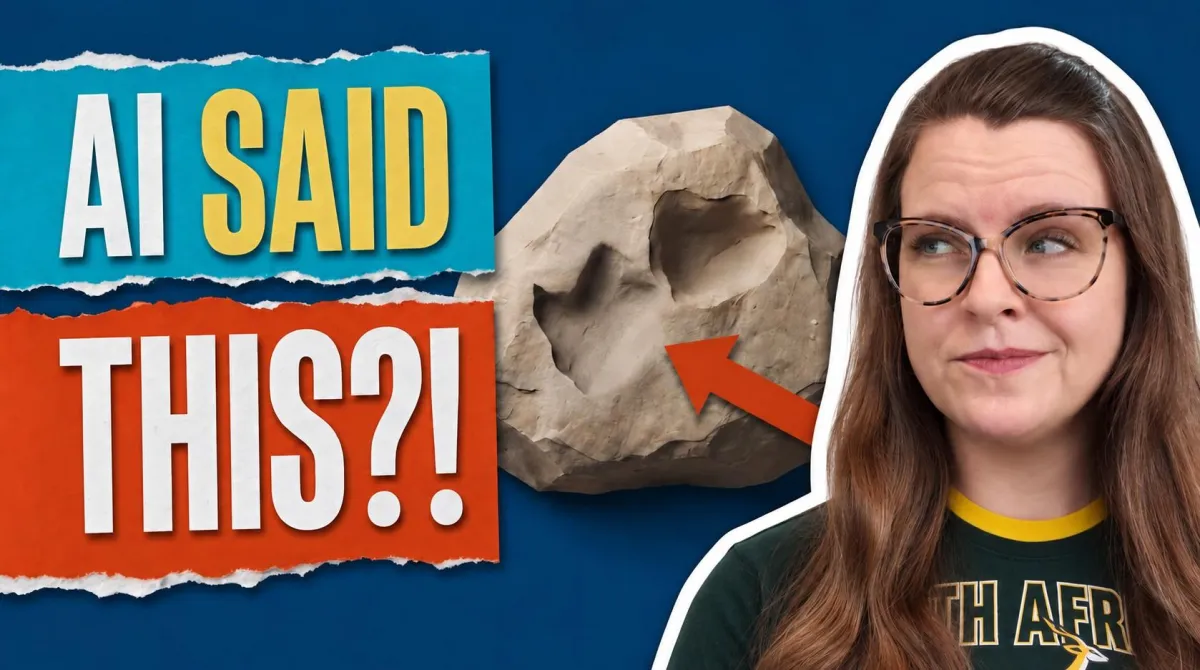
Take your phone out, go find any random rock outside, take a photo, and ask AI what dinosaur footprint it is. Just try it.
There is a real chance it describes the footprint, explains the toe shape, and names the dinosaur—for a rock that has never been near a fossil in its life.
It’s funny, for sure. But that is exactly what happens when you ask artificial intelligence to audit your marketing.
Today, we will show you why AI audits produce convincing answers to the wrong questions, and what a real marketing investigation actually looks like.
TL;DR
AI can accept the assumption inside your question and build a very convincing answer around it, even if the premise is entirely false.
AI audits frequently flag "critical" issues (like duplicate blog URLs) that are actually just standard search engine mechanics operating normally.
Service-business owners must stop chasing technical noise. A long list of red flags is not a strategy, and a high website-health score is not a reliable pipeline.
👉 Getting your positioning right is actually only one of ten elements of a Failure-Proof Marketing System. To discover the other nine elements you need to build a pipeline you can trust, download The Failure-Proof Marketing Roadmap.
Table of Contents
I Asked AI to Audit My Marketing and It Found a Dinosaur
The Rock That Fooled the Machine
Diagnosing Problems That Aren't Problems
Better Questions Don't Fix What’s Broken
What a Real Marketing Investigation Starts With
1. Stop Asking AI for a Marketing Strategy Until You Watch This
2. Why Your Marketing Isn't Working (And It's Not Because You're Lazy)
3. Your Marketing Isn't Broken. One of These Three Things Is
4. Why Service Businesses Get Stuck in Feast or Famine (And How to Fix It)
5. What to Fix First When Your Marketing Stops Working (The Order Matters)
1. Can AI tools accurately audit my website?
2. Why do AI audits give confident answers to wrong problems?
3. Are technical SEO warnings always urgent?
4. How do I know if my marketing agency's reports actually matter?
The Rock That Fooled the Machine
I’m Vicky Sidler, a StoryBrand Certified Guide, and I help established service businesses turn underperforming marketing into predictable growth with a Failure-Proof Marketing System.
And I know exactly how convincing those AI answers can be, because AI did not find a footprint in that rock; it simply accepted the assumption that one existed, and then happily filled in everything around it.
I was hiking in the mountains in Clarens with my niece, who found an interesting rock and was absolutely certain it was a dinosaur footprint. The area has fossil sites, a dinosaur museum, and enough prehistoric atmosphere that the assumption felt almost reasonable. Now, I did not think it was a dinosaur footprint. It looked like a rock. Possibly an interesting rock. But still a rock.
However, she was excited, and I support children’s curiosity right up until it involves climbing through a thorn bush, touching something dead, or buying an overpriced plushie dinosaur from a gift shop. So, we asked AI: "What dinosaur footprint is this?" It came back with a detailed report, the toe shape, the likely species, and enough science-adjacent language to make a grown adult briefly wonder whether we had stumbled onto something real.
But it was just a rock.
A few weeks later, while hiking with a friend, I tried again with a completely ordinary rock—no unusual shape, absolutely no fossil context, no suggestive dents—and asked the exact same question. I got the exact same result: a confident, highly structured explanation of the dinosaur that had apparently crossed it.
AI researchers literally call this a hallucination—an answer that sounds coherent and grounded but is built entirely on an accepted premise rather than actual evidence. OpenAI's own research points out why: language models are often rewarded for producing confident answers rather than admitting uncertainty. So "I don't know" loses to a plausible-sounding explanation, even when the plausible explanation is total nonsense.
The problem is not that AI is broken; the problem is that it blindly accepted the assumption inside the question without ever checking whether the assumption was true. Which is a deeply curious thing when you consider what most business owners hand to AI when they want to know what is wrong with their marketing.
Diagnosing Problems That Aren't Problems
Because a long list of red flags is not a diagnosis, and treating it like one is exactly how you spend months fixing things that absolutely didn't need fixing.
A client recently came in with an AI-generated website audit. It had pages of findings, technical warnings, critical issues, and enough red and amber circles to make the site look like a small aircraft with every single engine light flashing simultaneously. One major red flag stated that Google was not indexing a large number of blog URLs, which sounded incredibly serious.
It was not serious. It was just Google doing exactly what Google is supposed to do.
The site used blog widgets in multiple places, like on thank-you pages after enquiry forms. That is genuinely smart strategy: someone who just made an inquiry is interested enough to want more, so showing them useful articles keeps them on the site and builds trust. But the widget created additional URL paths, so the exact same article appeared as /blog/how-to-improve-cash-flow and also as /thank-you/blog/how-to-improve-cash-flow. It was the same article and the same content, just different paths—and when Google finds duplicate content, it selects one representative version to rank rather than indexing every single copy.
The technical tidy-up was straightforward: we added canonical tags so each duplicate version pointed to the preferred blog URL. But adding canonical tags did not magically make all those extra blog URLs get indexed. Hundreds of them were still listed as not indexed.
That was the correct result.
Google has seen millions of widgets like these and knows how to handle them with or without canonical tags. It was never going to index every duplicated instance of a page. Think about it from a user point of view. How annoyed would you be if you did a Google search only to find a bunch of listings on identical pages with different URLs?
But the big scary AI finding did not say, "this may be a URL pattern worth checking"—it confidently declared, "Google is not indexing these pages, serious red flag!" Those are two wildly different statements. The first is a hypothesis; the second is a dinosaur report about a rock.
👉 If you want to know which part of your marketing is actually holding the business back—not what an AI blindly flags, but what genuinely blocks growth—The Failure-Proof Marketing Roadmap lays out the 10 essential elements that help established service businesses end underperforming marketing and attract more consistent, better-fit clients.
The Room That Goes Quiet
The most expensive report in your business is the one that makes you feel incredibly busy while the real problem goes completely unexamined.
The trap is paying an SEO company for technical health reports, someone else for paid ads, another person for social content, plus a CRM, an email platform, a keyword tool, a design subscription, an analytics dashboard, an AI subscription, and probably one platform you bought in 2023 because a webinar made it sound absolutely necessary.
Everyone is doing things. Everyone has a shiny report. Everyone can point to activity.
But then you ask the only question that actually matters: "Which of these is producing qualified clients and profitable revenue?" And suddenly, the room goes very, very quiet.
A 2026 B2B survey found that 79% of marketing leaders say they struggle to demonstrate marketing's impact on business success, and 67% say they don't clearly understand which outcomes senior leaders expect marketing to influence at all.
This is exactly how AI audits and generic agency reports become dangerous. Not because they are malicious, but because they give everyone more things to do, more things to bill for, and a highly convincing sense that something is improving, while the core commercial question stays completely unanswered. A high website-health score is not a pipeline. A completed task list is not a return on investment. A list of technical issues is not a plan.
The question is never, "can we find something wrong with this website?" Any sufficiently large website has something wrong with it, including a hidden page with an image named FINAL-final-image-use-this-one-2.jpg. The real question is: "What is the one change most likely to improve the quality and predictability of clients coming into this business?"
Better Questions Don't Fix What’s Broken
It misses the fact that asking AI smarter questions about your marketing is a bit like asking the dinosaur expert more intelligent questions about the rock. The quality of the question doesn't magically change what is sitting in front of you.
Better prompts can certainly help, but they only help if you already know which question matters, and that knowledge is exactly what is missing. How do you know whether you have a traffic problem or a positioning problem? How do you know whether the website needs a rewrite or the offer itself needs work? Whether the ads are broken or the lead generator is just attracting the wrong people? How do you know whether a technical warning is an urgent fire or just an untidy corner of the internet?
You don't. And that is not a criticism; that is exactly why expertise exists.
You wouldn't ask an AI to diagnose a strange noise in your car, receive a 14-step engine-rebuild plan, and immediately remove the gearbox in your driveway because the chatbot used the word "critical." Most of us want an experienced human being to work out whether the issue is actually serious, what caused it, and what should genuinely happen next.
Marketing is exactly the same. AI can produce a million answers, but a real strategist has to determine whether the question is even right to begin with.
What a Real Marketing Investigation Starts With
A real investigation starts with the actual business—not the website score, not the generated AI report, and definitely not a list of 50 blog ideas.
The starting point is the current strategy, the offer, the competitors, the website, the existing content, the traffic sources, the lead flow, and the follow-up process—all of it looked at together, not in separate, siloed reports.
Then, you look for actual evidence. What do the best clients have in common? What problem did they genuinely believe they were paying to solve? What exact language do they use to describe it? Where do good prospects suddenly stop moving forward? Which sources actually bring the best-fit leads, and which pages help people decide to finally get in touch?
Then, absolutely everything that comes out of that investigation goes into two very specific piles: "looks unusual but isn't particularly important" and "this is actively blocking growth." That second pile is exactly where real strategy begins.
Think back to the client of mine who came in with the AI audit. If they had blindly followed every warning, they could have spent weeks and significant money on duplicate URL fixes while the high-leverage work went completely untouched. They would have ignored clarifying the offer, strengthening their positioning, improving how the website explained value, building a follow-up path so inquiries didn't disappear, and choosing traffic sources that produced real opportunities rather than just busy activity.
AI can help organize information, it can explain what canonical tags are, it can summarize reports, and it can absolutely create a starting list to speed up parts of the work. But it cannot know your business priorities from a URL. It cannot reliably separate "this is broken" from "this looks unusual but makes sense in context." And it absolutely cannot take responsibility when you spend three months fixing things that didn't actually need fixing.
Before you let an automated report tell you what to fix in your business, it is worth making absolutely sure you are looking at a real footprint—because you may just be holding a rock.
Related Articles
1. Stop Asking AI for a Marketing Strategy Until You Watch This
If you are tempted to rely on AI for your entire marketing plan, this article breaks down the prompt-roulette and yes-man problems that guarantee generic advice.
2. Why Your Marketing Isn't Working (And It's Not Because You're Lazy)
If you are exhausted by chasing random website warnings and tactical fixes, this article explains why you have an architecture problem, not a discipline problem.
3. Your Marketing Isn't Broken. One of These Three Things Is
If your website traffic is bouncing and you don't know why, this piece walks you through the exact 5-second diagnostic tests to check your presence, offer, and flow.
4. Why Service Businesses Get Stuck in Feast or Famine (And How to Fix It)
If your marketing activity feels like a series of disconnected fragments that never produce predictable revenue, this guide shows you how to build a unified system.
5. What to Fix First When Your Marketing Stops Working (The Order Matters)
If you have a massive list of marketing to-dos and no idea where to start, this article establishes the strict 4-part sequence of leverage you must follow.
FAQs
1. Can AI tools accurately audit my website?
AI can scan code and point out technical anomalies, but it lacks context. It often flags standard search engine mechanics (like duplicate paths from widgets) as critical errors, leading you to fix non-issues while ignoring core strategic flaws.
2. Why do AI audits give confident answers to wrong problems?
Language models are trained to maximize plausibility and user satisfaction rather than admit uncertainty. If you ask a leading question, the AI will build a coherent narrative around your premise, even if the premise is false.
3. Are technical SEO warnings always urgent?
No. Large websites almost always have minor technical anomalies or duplicate URL paths. A warning is only important if it directly blocks search engines from ranking your core pages or prevents users from converting.
4. How do I know if my marketing agency's reports actually matter?
Ask a simple question: does this report connect directly to qualified clients and profitable revenue, or is it just tracking activity? If an agency can only show you task completion metrics without pipeline growth, you are looking at maintenance, not strategy.
5. What should a real marketing audit start with?
A real marketing audit starts with your business fundamentals: your offer, your positioning, your target audience, and your actual client data. Technical website health is only evaluated after your core message and conversion path are secure.