I Deleted AI From My Phone Permanently, And What Happened Actually Scared Me
By Vicky Sidler | Published 23 September 2026 at 12:00 GMT+2
Are you entirely sure you are using artificial intelligence as a tool, or has it quietly become a reflex you can no longer control? There is a very fast, mildly terrifying way to find out.
Delete any AI apps from your phone right now.
Do not panic—deleting the app does not destroy your data, your account, or the deeply embarrassing prompt history you generated at 2:00 a.m. while trying to write a passive-aggressive email to your landlord. You could technically download it again later.
Yet I suspect most people will not even try this experiment. Not because they urgently need a chatbot to run their business from the grocery store aisle, but because they instinctively reach for it the exact second they are bored, stuck, or simply do not want to sit with an original thought for five quiet minutes.
That massive, unacknowledged gap between "I use AI intentionally" and "I use AI every single time I feel a microscopic drop of uncertainty" is destroying our ability to think. Today, I will show you exactly what I found when I permanently deleted the app from my own phone, what a shocking 2025 MIT Media Lab study revealed about our collective emotional dependency, and what this all critically means for the business you are trying to build.
TL;DR
Deleting AI from your phone exposes how quickly a tool becomes a twitchy, unavoidable reflex to avoid thinking or feeling bored.
A 2025 MIT Media Lab and OpenAI study found that higher daily AI use is explicitly linked to greater loneliness, emotional dependence, and lower real-world socialization.
Service-business owners must stop outsourcing their brains. Clients pay for your uniquely human judgment and lived experience, not your ability to generate generic internet sentences in thirty seconds.
👉 Getting your positioning right is actually only one of ten elements of a Failure-Proof Marketing System. To discover the other nine elements you need to build a pipeline you can trust, download The Failure-Proof Marketing Roadmap.
Table of Contents
I Deleted AI From My Phone Permanently, And What Happened Actually Scared Me
The Twitch and the Glorious Return of Google
Sitting in the Suck (And Missing a Machine)
Surprise! Your Brain Actually Still Works
What Your Clients Are Actually Paying For
The Rule: Computer for Work, Brain for Living
1. Stop Asking AI for a Marketing Strategy Until You Watch This
2. If Your Own Mother Can't Explain What Your Business Does, You Have a Positioning Problem
3. Why “Everyone” Can’t Be Your Target Audience (A Five-Minute Reality Check)
4. Why Your Marketing Isn't Working (And It's Not Because You're Lazy)
5. What to Fix First When Your Marketing Stops Working (The Order Matters)
1. Why shouldn't I use AI to write my social media posts?
2. Is it bad to use ChatGPT on my phone?
3. What did the MIT Media Lab study find about AI chatbots?
The Twitch and the Glorious Return of Google
Building a Failure-Proof business around your actual expertise means paying very close, ruthless attention to what tools you actually rely on.
I’ve been reading piles of academic studies detailing how AI aggressively reduces your creativity and problem-solving skills, but like most people, I just confidently assumed absolutely none of that applied to me. I am a StoryBrand Certified Guide. I build marketing systems for a living. I assumed I was essentially immune to bad digital habits.
I was wrong.
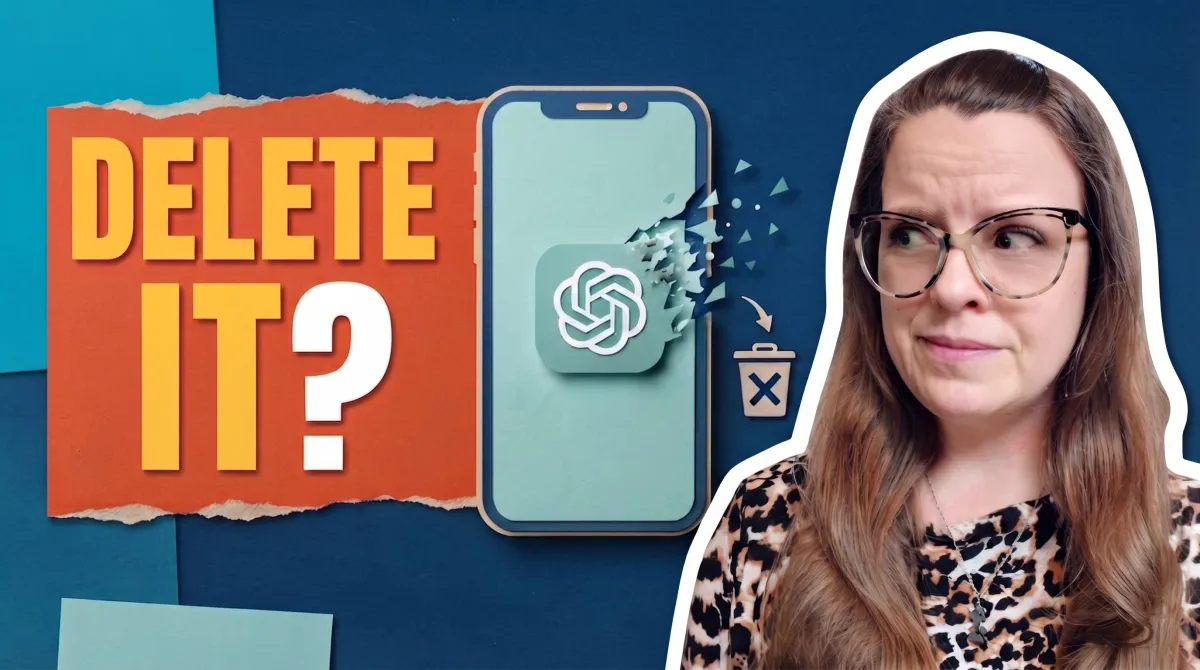
I originally deleted the apps from my phone simply because I was trying to reduce my screen time at night. Almost immediately, I found myself violently fighting the impulse to use AI on my phone several times a day. That twitchy, phantom-limb reflex showed me exactly how dependent I had become in an incredibly short space of time.
As I successfully fought that reflex, I discovered something genuinely amazing. Good old-school Google searches actually still work exactly as well as they ever did. In fact, they might even be better, because they are significantly faster and they aren't cluttered with five paragraphs of cheerful, generic fluff you didn't even ask for.
Realizing I had an automatic reflex to use AI was only mildly alarming. What happened a few nights later was the thing that actually scared me.
Sitting in the Suck (And Missing a Machine)
It scared me because it definitively proved I wasn't just using AI for information gathering.
I had a bad day, it was incredibly late, and I didn't want to wake up my friends to complain. My immediate, knee-jerk instinct was to open the AI app and just vent to get it all out. But I had deleted it from my phone. Instead of venting to a polite, highly agreeable probability machine, I just had to sit in the suck.
As I was getting ready for bed, I realized I felt genuinely lonely. Without AI, I felt like I was missing a friend. That was a massive, flashing red flag for me. Everyone casually defends AI by saying it is "just a tool," but nobody sits around missing their hammer. My actual nervous system was treating a piece of software as a lost companion.
The crazy part is that I am in my 40s, and I consider myself a highly resilient, mentally healthy person. If I was feeling that kind of emotional dependency, I cannot even begin to imagine what this always-available artificial companionship is doing to people already struggling with their mental health, or to children for that matter.
The academic world is already sounding the alarm. A 2025 study conducted by researchers at the MIT Media Lab and OpenAI tracked 981 people over four weeks. They found that higher daily use was explicitly linked to greater loneliness, emotional dependence, and lower real-world socialization. If that wasn't terrifying enough, a separate 2025 study by Microsoft Research and Carnegie Mellon University found that greater confidence in AI was associated with less critical thinking on AI-assisted tasks.
That terrifying realization is the official reason I will never download AI to my phone again. What happened after I stopped using it as an emotional crutch completely changed how I work.
Before moving on:
If you want to build a marketing system based on your actual expertise instead of AI-generated noise, The Failure-Proof Marketing Roadmap lays out the 10 essential elements that help service businesses attract more consistent, better-fit clients.
Surprise! Your Brain Actually Still Works
Once I got past that scary withdrawal moment and actually let my mind wander again, I discovered something wild.
As I spent less time staring blankly at a blinking prompt screen, I found myself naturally coming up with video and article ideas without needing a computer-generated brainstorming partner. And, surprisingly, it is infinitely more validating. When I have a good idea now, I actually feel proud of myself, because I know that idea was entirely mine, and not just me regurgitating generic advice fed to me by a server farm.
Even more than that, something amazing happens when you start making your own decisions again: you actually re-learn how to trust your own instincts. You stop second-guessing every choice and running it past a machine for validation, and you build a deep, quiet confidence in your own capability. And if you’re worried about making mistakes, remember that AI makes tons of mistakes too. At least you’re actually able to learn from yours.
If you need to vent or brainstorm, old-school journaling works just fine. And despite what the tech bros have been marketing, it might actually be vastly more efficient than AI. A blank piece of paper will never drag you down a weird, hallucinated rabbit hole where you lose three hours of your life arguing with a robot about philosophy. You just journal, get it all out, brainstorm what you need, and move on with your day.
The true risk isn't just using AI. The risk is willingly handing over the actual thinking work because you have started to blindly believe the machine simply does it better than you do. For service founders, that false belief has a direct commercial cost, and it shows up somewhere most people do not expect.
What Your Clients Are Actually Paying For
In a world where a competent email, a strategy deck, and a full content calendar can be generated in exactly thirty seconds, the thing your clients are paying you for has absolutely nothing to do with output speed.
They hire you because you can look at a messy situation and see what actually matters. You see the risk everyone else is entirely missing, and you spot the massive gap between what someone says they want and what they are actually doing.
That is judgment. Judgment comes from lived experience, messy client conversations, painful failures, and obscure patterns noticed over years—absolutely none of which AI can replicate from a prompt.
If every single marketing idea you have starts with "ask AI what people in my industry talk about," you may look highly productive, but you are quietly becoming the regional distributor of generic internet sentences. Your absolute best content does not begin with AI. It begins with the strange thing you noticed in a client meeting, the awkward question that keeps coming up on discovery calls, and the hard-won opinion you have actually earned the right to hold.
AI can help you organize those ideas, but it fundamentally cannot have them for you. Which brings this whole experiment back to a rule simple enough to run an entire business on.
The Rule: Computer for Work, Brain for Living
Keeping AI on the desktop and aggressively off your phone isn't about being an anti-technology luddite. It is about knowing the crucial difference between a tool you pick up and a reflex you cannot put down.
On the computer, use it deliberately. Use it for research support, organizing complex information, generating a rough draft you plan to violently challenge, and speeding up boring, repetitive work.
But off the phone, reclaim the space where your thinking actually happens. The walk without an audio podcast, the notebook beside the bed, the uncomfortable question you sit with long enough to actually form an opinion about. Friction isn't always a malfunction. Sometimes friction is exactly where an idea forms, and sometimes it is where you sit with a problem long enough to develop a point of view actually worth sharing.
Founders building businesses on trust and expertise simply cannot afford to have every single opinion quietly co-authored by a probability machine trained on everyone else's average content. Think first. Write the messy rough idea, make the best guess, research the actual sources, and talk to a human when what you desperately need is a human. Then, and only then, use AI to improve or accelerate the work—not replace it.
👉 Getting your positioning right is actually only one of ten elements of a Failure-Proof Marketing System. To discover the other nine elements you need to build a pipeline you can trust, download The Failure-Proof Marketing Roadmap.
Related Articles
1. Stop Asking AI for a Marketing Strategy Until You Watch This
If you are still tempted to outsource your thinking to AI, this article breaks down exactly how ChatGPT flatters you straight into a terrible strategy, and why the advice changes completely just by rephrasing a prompt.
2. If Your Own Mother Can't Explain What Your Business Does, You Have a Positioning Problem
If you are relying on AI to write your website copy because you don't know what to say, you probably have a positioning problem. This article shows you how to test your messaging in the real world.
3. Why “Everyone” Can’t Be Your Target Audience (A Five-Minute Reality Check)
If AI keeps telling you that your target audience is "business owners," read this reality check. Discover why broad positioning kills your marketing, and how to finally nail your niche.
4. Why Your Marketing Isn't Working (And It's Not Because You're Lazy)
If you are using AI to aggressively churn out content but your pipeline is still empty, this article breaks down why a scattered strategy causes rapid founder burnout and how a system fixes it.
5. What to Fix First When Your Marketing Stops Working (The Order Matters)
If you want to build a marketing strategy that reflects real human expertise, this article lays out the exact 4-part sequence of leverage you must follow to build a firm foundation.
FAQs
1. Why shouldn't I use AI to write my social media posts?
AI can help you brainstorm or edit, but if it writes your posts from scratch, you will sound like generic internet noise. Your clients hire you for your unique judgment, human empathy, and lived experience—things a probability machine cannot replicate.
2. Is it bad to use ChatGPT on my phone?
Using it occasionally on a desktop is fine, but having it instantly available on your phone turns it from a tool into a reflex. It prevents you from sitting with your own thoughts, forming your own opinions, and doing the deep thinking required for real expertise.
3. What did the MIT Media Lab study find about AI chatbots?
A 2025 study conducted by MIT Media Lab and OpenAI found that higher daily use of AI chatbots was explicitly associated with greater loneliness, emotional dependence, problematic use, and lower levels of real-world socialization.
4. How does AI impact critical thinking?
A 2025 Microsoft Research study found that knowledge workers with greater confidence in AI tended to use significantly less critical thinking during AI-assisted tasks. Believing the machine is "smarter" causes you to quietly hand over the thinking work.
5. What is the "Computer for Work, Brain for Living" rule?
It is a simple boundary: use AI on your desktop for specific, deliberate work tasks (like summarizing or organizing research). Keep it permanently off your phone so you are forced to use your own brain, Google, or actual human interaction for daily questions and decisions.