

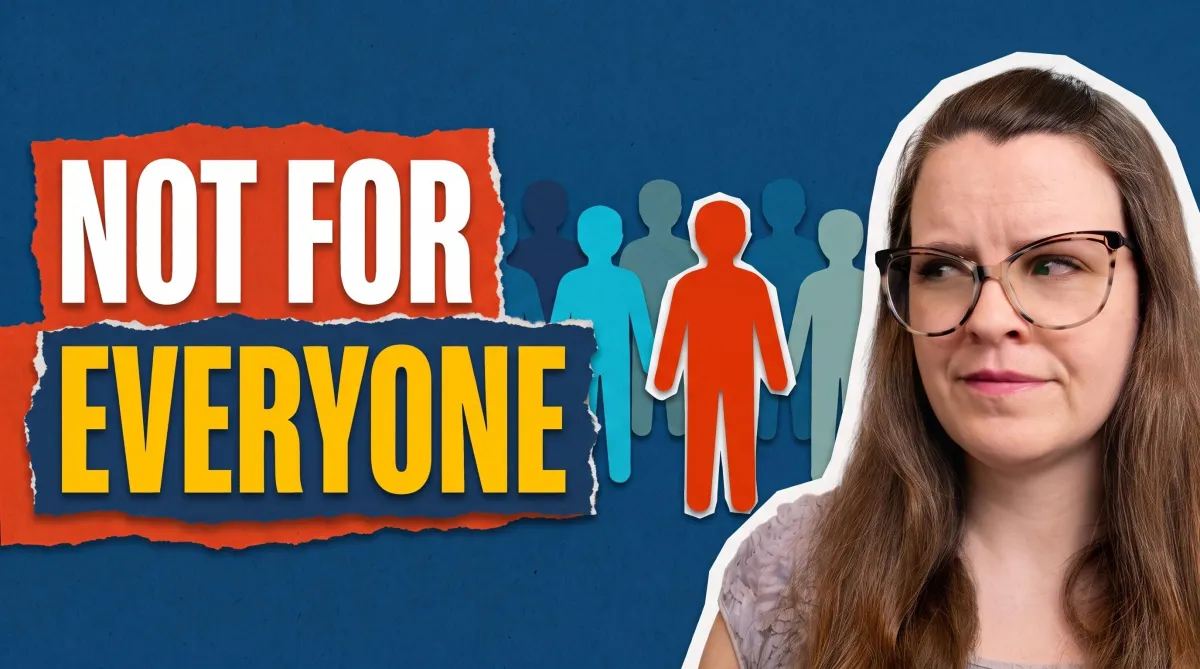
Why “Everyone” Can’t Be Your Target Audience (A Five-Minute Reality Check)
By Vicky Sidler | Published 9 September 2026 at 12:00 GMT+2
Have you ever confidently declared that your business can "help anyone," only to stare at an empty pipeline and wonder why all those millions of people aren't aggressively trying to hand you their money?
A lot of service-business owners tell me some version of this:
"Honestly, we can help anyone."
It is usually said with the calm confidence of a person who has just announced that water is wet. An accountant says anyone needs accounting. A consultant says every business needs strategy. A leadership coach says everyone could use better leadership. A web designer says every company needs a website. A physiotherapist says, technically, all humans have bodies.
And all of that may be broadly true. But it is not a target audience.
Here is a very quick test. Walk outside your front door. Find the next person who walks past. Explain your offer. Ask them to buy it. Could you do that? Would they need what you sell right now? Could they afford it? Would they understand why it matters? Would they be the person who can approve the decision?
Almost certainly not. Which means “everyone” is not your market. It is just what people say when they are afraid that choosing an audience means rejecting money.
TL;DR
If you could really sell to everyone, you could sell your service to the next stranger who walks past your front door. The fact that you can't proves your business already has criteria for a good-fit client.
Saying "everyone" makes your website vague, your content generic, your referrals fuzzy, your ads expensive, and your sales calls full of people who were never going to buy.
Buyers actively look for specialized expertise: 77% of B2B buyers say relevant content that speaks directly to their company matters when evaluating vendors, and 75% value content demonstrating specific industry needs.
👉 Getting your positioning right is actually only one of ten elements of a Failure-Proof Marketing System. To discover the other nine elements you need to build a pipeline you can trust, download The Failure-Proof Marketing Roadmap.
Table of Contents:
Why “Everyone” Can’t Be Your Target Audience (A Five-Minute Reality Check)
Why “Everyone” Feels Safe—and Costs You Money
The Cost of Having No Real Audience
You Are Allowed to Be Specific
1.Why Your "Great Offer" Isn't Selling (Hint: It's Not Your Messaging)
2. Why Your Marketing Isn't Working (And It's Not Because You're Lazy)
3. Your Marketing Isn't Broken. One of These Three Things Is
4. Why Service Businesses Get Stuck in Feast or Famine (And How to Fix It)
5. What to Fix First When Your Marketing Stops Working (The Order Matters)
1. Why is saying "we help everyone" a bad marketing strategy?
2. Will narrowing my target audience limit my revenue?
The Sidewalk Test
Let's make this painfully concrete. Imagine you run a specialist consultancy. You say: "We can work with anyone because every business needs help."
Fine. You step outside. The next person walking past is a university student on their way to class, a retired dentist walking their dog, a restaurant manager who cannot approve a $15,000 consulting project, or a new freelancer with no budget.
You would not try to sell to most of them. Not because you are bad at sales, but because they are not all equally likely to need, want, buy, benefit from, or be able to approve your service.
Congratulations: you have a target audience. You have probably had one the entire time. You just keep refusing to name it because “we help anyone” sounds safer than making an actual choice.
The Cellphone Delusion
Let's pause right here, because I can hear the objection forming in your head.
"But everyone has a cellphone!" you protest. "So surely anyone walking down the street could be a good fit for this new brand of phone I am trying to sell?"
Technically, yes, almost every human adult on the planet possesses a cellular device. But if you try to sell a $1,200 pro-gaming smartphone equipped with a liquid-cooling system and glowing neon edges to a 78-year-old grandmother who just wants to play Wordle and text her grandson, she is going to look at you like you have entirely lost your mind. Conversely, try pitching a basic flip phone with oversized, high-contrast buttons to a 22-year-old TikTok influencer.
They both need a phone, but they are buying fundamentally, aggressively different things. If your marketing tries to appeal to both of them simultaneously, it will appeal to absolutely no one.
You may genuinely be able to help a solo founder, a two-million-dollar professional-services firm, a fast-growing manufacturer, and someone whose cousin gave them your number. But they do not all have the same problem, the same urgency, the same budget, the same buying process, or the same likelihood of becoming a case study that brings you three more clients!
Choosing a target audience is not about who you are legally allowed to help; it is about choosing who to be the obvious first choice for. When a best-fit founder lands on your page and sees a message that describes their exact expensive problem, they do not think "oh, they only work with people like me, how limiting"—they think "finally, someone who actually gets this!"
Why “Everyone” Feels Safe—and Costs You Money
The emotional logic behind broad positioning is completely understandable. If you say your business is for accountants, you worry you will lose lawyers. If you say you serve companies above a certain size, you worry you will lose smaller clients.
So you stay broad. You say things like:
"We help businesses grow."
"We provide tailored solutions."
"We work across all industries."
And your marketing slowly becomes the business equivalent of unseasoned oatmeal: technically inoffensive, broadly available, and nobody’s first choice. Broad positioning does not make your market bigger. It makes your message less useful to the people most likely to pay you.
Current B2B buyer research makes this extremely inconvenient for generalists. Buyers say they value vendor content that speaks directly to their company and specific industry needs; 64% also say strong knowledge of their industry matters when they evaluate providers. Nobody wants to feel like they are hiring “a competent person who generally does things.” They want to feel like they are hiring someone who understands their expensive problem.
Before moving on:
Getting your positioning right is actually only one of ten elements of a Failure-Proof Marketing System. To discover the other nine elements you need to build a pipeline you can trust, download The Failure-Proof Marketing Roadmap.
The Cost of Having No Real Audience
When you refuse to define your audience, every single part of marketing gets exponentially harder:
Your website becomes vague: You cannot clearly state the problem you solve because there are too many possible problems. Your homepage says something like, "We help organisations unlock growth through tailored solutions," which is either a consultancy, a SaaS product, or a very confident extraterrestrial life-form.
Your lead generator attracts everyone except buyers: You create something broad like "The Ultimate Guide to Business Success" and end up with hundreds of downloads from people who enjoy free PDFs but have no budget or authority to buy.
Your referrals stay vague: When a happy client wants to recommend you, they say, "You should speak to Vicky. She does marketing." This forces the potential referral to solve a puzzle with a missing piece. Compare that to a sharp referral that names the exact expensive problem you solve.
Your sales calls become exhausting: A vague audience produces calls with people who want something different, cannot afford you, or need services you do not provide. Then you conclude that leads are bad. They aren't bad—they are behaving exactly as your broad message invited them to behave.
The Audience You Already Have
You do not need to invent a niche by pointing at a random industry list. Start with evidence. Look at the clients you already have—or the ones you wish you had more of—and ask:
Who gets the fastest, clearest result from our work?
Who values our expertise instead of treating us like a commodity?
Who has an expensive enough problem to solve it properly?
What was happening immediately before they looked for help?
Your target audience is often not just a job title or an industry. It is a person with a specific trigger event. For example: a professional-services founder whose referrals have slowed down, or a specialist consultant who is fully booked today but terrified to hire because future demand is unpredictable.
Now you have someone you can recognize, write for, and help.
You Are Allowed to Be Specific
Your business can still accept a project outside your primary target audience. You can still take an unusual opportunity if it makes commercial sense.
But your public message needs to make one group of people feel like you built the business with them in mind. Because when your best-fit prospects feel seen, they don't think, "Oh, how limiting."
They think: "Finally. Someone who understands the problem I have been trying to explain."
That is what good positioning does. And if your answer is still “everyone,” try the sidewalk test. Go outside. Sell to the next person who walks past. I will wait.
👉 Stop making your ideal clients guess whether you are for them. To discover the other nine elements you need to build a pipeline you can trust, download The Failure-Proof Marketing Roadmap.
Related Articles:
1.Why Your "Great Offer" Isn't Selling (Hint: It's Not Your Messaging)
If you are struggling to sell because your positioning is too broad, this article explains why a misaligned strategy is destroying your sales and how to fix it.
2. Why Your Marketing Isn't Working (And It's Not Because You're Lazy)
If you are exhausted by doing "all the things" for everyone, this article breaks down why a scattered strategy causes founder burnout and how a system fixes it.
3. Your Marketing Isn't Broken. One of These Three Things Is
If your broad presence is causing strangers to bounce from your website in 50 milliseconds, this piece breaks down the exact diagnostic tests you need to run.
4. Why Service Businesses Get Stuck in Feast or Famine (And How to Fix It)
If trying to appeal to "everyone" leaves your pipeline empty every few months, this article shows you how to stabilize your revenue.
5. What to Fix First When Your Marketing Stops Working (The Order Matters)
If you are ready to narrow your audience and fix your foundation, this article lays out the exact 4-part sequence of leverage you must follow.
FAQs:
1. Why is saying "we help everyone" a bad marketing strategy?
Saying you help everyone makes your message vague and unmemorable. Buyers look for specialists who understand their exact industry and expensive problems. Broad positioning forces you to compete purely on price.
2. Will narrowing my target audience limit my revenue?
No. Narrowing your audience makes your messaging magnetic to the right people. Instead of trying to convince a massive, indifferent crowd, you become the obvious, high-ticket choice for a specific group with urgent buying intent.
3. What is the Sidewalk Test?
The Sidewalk Test is a mental exercise where you imagine trying to sell your service to the next random stranger who walks past your front door. If they wouldn't understand, afford, or need it right now, "everyone" is not your market.
4. How do I define my target audience without guessing?
Look at your most profitable past clients. Identify their job titles, industries, but most importantly, their trigger events—the specific moment of pain or urgency that forced them to look for help.
5. Can I still take clients outside my target audience?
Yes. Defining a target audience is a public positioning decision for your marketing, not a legal contract. You can still accept outliers, but your core messaging must speak directly to your ideal buyer.