

STORY, MEET STRATEGY
Let’s make marketing feel less robotic and more real.
Find resources that bring your message—and your business—to life.
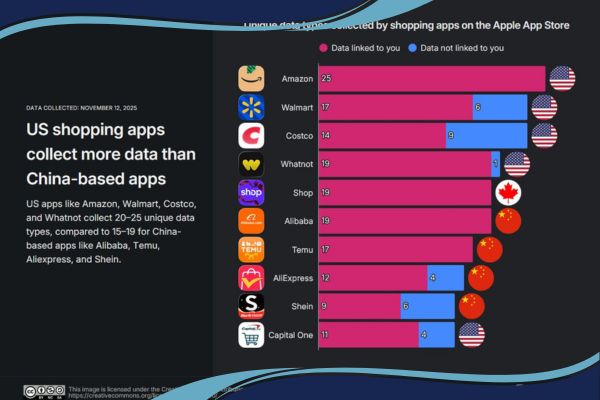
Shopping Apps Ranked by How Much Data They Take
By Vicky Sidler | Published 8 December 2025 at 12:00 GMT+2
If you’re thinking of leaving your Christmas shopping to the 22nd again, consider this your friendly PSA: start now. Especially if you’re ordering online. Those “guaranteed delivery” dates have a habit of disappearing faster than your will to wrap gifts at 2am.
But before you start downloading a dozen shopping apps in a caffeine-fueled spree, it’s worth asking: what are you giving up in exchange for convenience?
A new study from Surfshark shows that several of the most popular shopping apps are quietly collecting a staggering amount of personal data. Not just your cart contents. Some are scooping up voice recordings, phone contacts, and even details about your health, race, or political views.
Let’s break it down so you can make smarter decisions in your own business—and maybe rethink your shopping habits too.
TL;DR:
Amazon collects the most user data of all shopping apps
US-based apps collect more than Chinese or Canadian apps
Apps like Amazon, Walmart, and Alibaba even collect voice recordings
Some apps share your info with advertisers and data brokers
Most of the data is linked to individual user profiles
👉 Need help getting your message right? Download the 5-Minute Marketing Fix
Table of Contents:
Shopping Apps Ranked by How Much Data They Take
What These Apps Are Actually Collecting:
The "Other Purposes" Loophole:
Why This Matters to Small Business Owners:
Want to Clarify Your Message Instead of Spying on Customers?
1. AI Slop Is Breaking the Internet—Here’s What Small Brands Can Do
2. Meta’s AI Spending Spikes But There’s No Product
3. Customer-Aligned Branding: How to Build a Brand That Actually Fits
4. AI Marketing Trust Gap Widens as Consumers Push Back
5. How to Find Out What Customers Really Want
Frequently Asked Questions About Shopping App Data Collection
1. Which shopping app collects the most data?
2. Do US-based shopping apps collect more data than Chinese apps?
3. What kind of personal information do most apps collect?
4. Are these apps sharing data with third parties?
5. Why do apps collect so much data?
6. Should I be worried about apps collecting sensitive data?
7. Why does Amazon have an “Other Purposes” category for so much data?
8. How can small businesses learn from this?
9. What is the risk of collecting too much data as a business?
10. How much customer data do I actually need as a business owner?
What These Apps Are Actually Collecting:
The Surfshark study analysed the top 10 shopping apps in the US based on AppMagic rankings. That list included big names like Amazon, Walmart, Shein, and AliExpress.
Of the 35 possible data types tracked in Apple’s App Store privacy labels, Amazon collects 25. Walmart and Costco follow closely at 23 each. Chinese apps collect less but not by much—Alibaba grabs 19, Temu 17, and Shein 15.
And it’s not just your name and payment details. Every single app on the list collects your:
Name
Email
Address
Payment info
Search history
Product interactions
User ID
But they don’t stop there. Most also grab your:
Location
Device ID
Phone number
Photos or videos
Except in rare cases like Shein (no location) or Temu (no device ID), the collection is pretty much full sweep. Most of it is tied directly to you, which allows for extremely detailed user profiling.
And once they have it, they often share it.
Who Are They Sharing It With?
Seven of the ten apps share your data with outside parties. That includes advertisers and data brokers.
Let’s spell that out. If you use Amazon, Walmart, Costco, Alibaba, Whatnot, Shein, or Capital One Shopping, there’s a good chance someone else has access to your user ID, device ID, or browsing history.
Some examples:
Walmart shares your purchase history, device ID, and user ID
Alibaba shares your name, email, and physical address
Amazon shares advertising data and your user ID
Costco shares browsing history
Whatnot shares usage data and user ID
This isn’t just about ads. It’s about the broader issue of data control. Once your information leaves the app, it’s hard to track where it ends up.
The "Other Purposes" Loophole:
Apple’s privacy framework lists six standard reasons for data collection. The last one, “Other Purposes,” is vague to the point of useless. It means the company can collect data for reasons not listed anywhere.
Amazon collects 20 different types of data under this category. The next closest is Shein with just three.
So what’s Amazon doing with it all? We don’t know. That’s the problem.
The Weird Stuff:
Let’s talk about the odd and unsettling bits.
Amazon and Walmart collect “sensitive” data like race, political views, biometric or genetic data, sexual orientation, or pregnancy status
Whatnot and Alibaba access your phone’s contact list
Amazon, Walmart, Whatnot, and Alibaba collect your voice recordings
Voice recordings. For a shopping app. Let that sink in.
Why This Matters to Small Business Owners:
You’re not Amazon. You don’t need 25 categories of personal data. You just need enough to serve your customers well and keep their trust.
Here’s what you can take away from this:
Data is valuable, but so is restraint. If you collect too much, people get uncomfortable.
Transparency matters. Tell people what you’re collecting and why.
Don’t confuse “more data” with “better marketing”. The key is relevance, not volume.
Respect privacy. Especially if you’re in a service-based business built on relationships.
The more you collect, the more you're responsible for. That includes storage, security, and explaining what you're doing with it.
As a StoryBrand Certified Guide and Duct Tape Marketing Consultant, I’ve seen too many businesses fall into the trap of overcollecting without a clear purpose. It doesn’t just annoy customers. It can backfire legally and ethically.
Use the tools you need. Skip the ones you don’t. And always be able to explain your choices in plain English.
Want to Clarify Your Message Instead of Spying on Customers?
If you want a simpler way to connect with customers without digging through their phone, try this instead.
Download the 5 Minute Marketing Fix and get one clear sentence that explains what your business does and why it matters.
Related Articles:
1. AI Slop Is Breaking the Internet—Here’s What Small Brands Can Do
If shopping apps collecting voice recordings gives you the ick, this one explains how AI-generated junk is flooding the web—and how your business can rise above it.
2. Meta’s AI Spending Spikes But There’s No Product
Worried your data's being used to fund pointless AI projects? This article explores Meta’s AI obsession and why small businesses should care where tech money is going.
3. Customer-Aligned Branding: How to Build a Brand That Actually Fits
This one shows you how to build a brand that reflects your customer’s values—without spying on their contact list or voice memos.
4. AI Marketing Trust Gap Widens as Consumers Push Back
Customers love convenience but hate creepy. Learn how to market with AI while protecting privacy and building trust.
5. How to Find Out What Customers Really Want
Before you collect 35 data points, try asking them. This guide teaches low-cost, high-trust ways to get the insights you actually need.
Frequently Asked Questions About Shopping App Data Collection
1. Which shopping app collects the most data?
Based on the Surfshark study, Amazon collects the most data out of the top ten shopping apps analysed. It collects 25 out of the 35 data types listed in Apple’s privacy framework.
2. Do US-based shopping apps collect more data than Chinese apps?
Yes. The study found that US-based apps such as Amazon, Walmart, Costco, and Whatnot collect more data types on average than Chinese apps like Temu, Shein, or AliExpress.
3. What kind of personal information do most apps collect?
Every app in the study collects basic information such as your name, email address, payment details, purchase activity, and search history. Most also collect device IDs, photos or videos, and location data.
4. Are these apps sharing data with third parties?
Yes. Seven of the apps share collected data with outside companies, advertisers, or data brokers. Once shared, control over how that information is used becomes limited.
5. Why do apps collect so much data?
Apps collect data to personalise shopping experiences, improve targeting for ads, track user behaviour, and in some cases sell or share data with brokers or marketing platforms.
6. Should I be worried about apps collecting sensitive data?
If an app collects sensitive data such as biometric information, political views, health details, or voice recordings, it is reasonable to ask why they need it and how it will be used.
7. Why does Amazon have an “Other Purposes” category for so much data?
Apple allows apps to label some collected data under “Other Purposes,” which means the app does not need to specify exactly how or why it is collecting it. Amazon collects 20 data types under this vague category.
8. How can small businesses learn from this?
Small businesses do not need to gather large amounts of personal data. Clear messaging and trust-based communication usually perform better than aggressive tracking.
9. What is the risk of collecting too much data as a business?
The more you collect, the more you are responsible for storing and protecting. That responsibility includes explaining how the data is used and complying with privacy laws.
10. How much customer data do I actually need as a business owner?
Most small service-based businesses only need enough information to communicate, deliver services, and build relationships. If you cannot explain why you are collecting a specific data point in plain English, you probably do not need it.
👉 Need help simplifying your marketing so customers understand you without needing tracking tools to do the heavy lifting? Download the5 Minute Marketing Fix.



Is your Marketing Message so confusing even your own mom doesn’t get it? Let's clarify your message—so everyone wants to work with you!






Created with clarity (and coffee)