
Real news, real insights – for small businesses who want to understand what’s happening and why it matters.
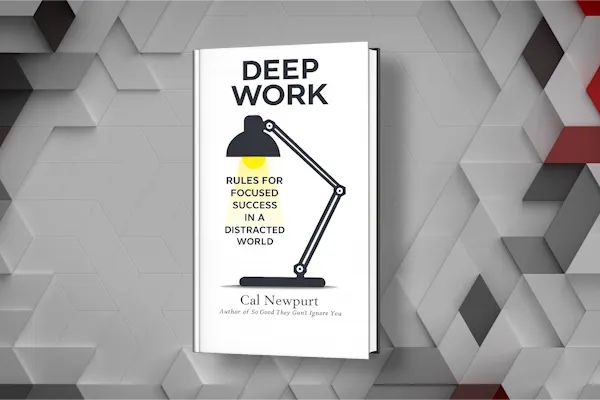
Deep Work By Cal Newport Summary: Why Checking Email Is Bankrupting You
By Vicky Sidler | Published 17 May 2026 at 12:00 GMT+2
If you think you had a "highly productive" day because you answered seventy-five emails, attended three Zoom meetings, and cleared out your Slack notifications, I have some truly terrible news for you. You did not do any actual work today. You just performed high-speed clerical chores while your core business slowly rotted away.
This brutal reality is the absolute core of Deep Work by Cal Newport. We have entered the "Great Restructuring" of the global economy, and the middle ground of "good enough" service is rapidly evaporating. If your daily output consists entirely of things that an automated machine or a cheap global freelancer could do, your business is a commodity, and commodities get crushed.
As a StoryBrand Certified Guide, I constantly see brilliant business owners utterly paralyze their own growth because they are drowning in logistical chaos. They think checking their inbox every five minutes makes them "responsive." In reality, it makes them broke.
Let’s rip apart the devastating biological cost of distraction, explore why constant context-switching is literally damaging your brain, and uncover how to build a fortress of Deep Work to protect your profitability.
TL;DR:
Deep Work is distraction-free, highly concentrated effort that pushes your brain to its limit to create high-value, hard-to-replicate output.
"Shallow Work" (like answering emails and checking Slack) is logistical busywork that does not create wealth. In a winner-take-all economy, prioritizing shallow work is a death sentence.
Every time you do a "quick check" of your inbox, you create "Attention Residue" that severely damages your cognitive capacity and actively erodes your billable efficiency.
👉 If your business operates in a constant state of frantic distraction, your customer experience will be chaotic and unmemorable. You must establish secure, undeniable human authority. Download the 5-Minute Marketing Fix to craft a powerful StoryBrand One-Liner that standardizes your brand message, giving you a scalable, repeatable way to earn trust without constantly interrupting your own workflow.
Table of Contents:
Deep Work By Cal Newport Summary: Why Checking Email Is Bankrupting You
Why Is Your "Hustle" Actually Making You Irrelevant?
What Is "Attention Residue" And Why Is It Destroying Your Brain?
How Do You Stop Drowning In The Shallows?
Why Is A "Shutdown Ritual" The Ultimate Power Move?
1. The E-Myth Revisited By Michael Gerber Summary: Why Your Business Is Just A Terrible Job
2. Company of One by Paul Jarvis Summary: Why Scaling Will Kill Your Business
3. Why Your AI Assistant Keeps Forgetting Your Instructions (And How To Fix It)
4. Why The Internet Is Drowning In AI Slop (And How To Keep Your StoryBrand Clean)
5. Why ChatGPT Is Literally Boiling Your StoryBrand Brain
1. What is the difference between Deep Work and Shallow Work?
2. What is "Attention Residue"?
3. What is the "Deep Work Hypothesis"?
Why Is Your "Hustle" Actually Making You Irrelevant?
Because if your daily routine can be easily replicated by a smart 22-year-old recent graduate, you are not actually creating any unique value in the market.
Newport splits all professional effort into two categories. Deep Work consists of activities performed in a state of distraction-free concentration that push your cognitive capabilities to their absolute limit. These efforts create new value, improve your skill, and are incredibly hard to replicate. Shallow Work, on the other hand, consists of non-cognitively demanding, logistical-style tasks—like managing your inbox—often performed while distracted.
The "Deep Work Hypothesis" states that the ability to perform deep work is becoming increasingly rare at the exact same time it is becoming increasingly valuable. In the professional services market, there is an exponential premium on being a "Superstar." The elites win the bulk of the market, while everyone else fights for the scraps. If you spend your entire day mired in the "cranking widgets" of administration, you cannot produce the high-margin, non-derivative assets required to survive. Depth is the engine of profitability; shallowness is the path to irrelevance.
What Is "Attention Residue" And Why Is It Destroying Your Brain?
Because your inability to focus is not a moral failing or a lack of willpower; it is a brutal, measurable biological limitation of your brain.
Neuroscience shows that high-level productivity requires your neural circuits to fire cleanly and efficiently. This only happens when you fire a specific circuit repeatedly and in total isolation. If you attempt to work while distracted, you fire too many circuits haphazardly, completely failing to strengthen the specific neurons required for mastery.
This brings us to the devastating concept of Attention Residue. Research proves that when you switch from writing a complex client proposal to "quickly checking" an email, your attention does not immediately follow. A thick "residue" of your focus remains stuck on the email, leaving you with drastically fewer cognitive resources for your primary, high-value task. This residue ensures you are never operating at full capacity. It is the reason you feel completely exhausted at 5:00 PM even though you haven't produced a single piece of meaningful work all day.
How Do You Stop Drowning In The Shallows?
Because if you don't actively build a fortress around your concentration, the chaotic demands of your clients and employees will consume every waking hour of your life.
You cannot just "try harder" to focus; you have to architect a system. Newport suggests four scheduling philosophies, but for most small service businesses, the Rhythmic Philosophy is best. You must transform deep work into a simple, non-negotiable habit—like a set three-hour block every single morning—to completely remove the daily negotiation of when you are going to work.
You also need to aggressively cap your Shallow Work. You have to institute a Fixed-Schedule Productivity rule: set a hard, non-negotiable finish time for your workday (e.g., 5:30 PM). This forces you to work backward, finding brutal efficiencies to satisfy the constraint. And finally, you must become hard to reach. Stop ending emails with "thoughts?" Start using "Process-Centric Emails" that identify the exact next steps, times, and requirements to close the loop in a single exchange.
Why Is A "Shutdown Ritual" The Ultimate Power Move?
Because if you take your work home with you in your head, you are completely sabotaging your ability to perform at an elite level tomorrow.
You must ritualize the end of your day. To restore your cognitive capacity, you have to neutralize the "Zeigarnik Effect"—the psychological tendency of unfinished tasks to absolutely dominate your attention and ruin your evening. You need a strict Shutdown Ritual: check the inbox one last time for urgent items, capture all unfinished tasks into a trusted system, review your calendar for the next 48 hours, and make a rough plan for tomorrow.
Then, you must say a set phrase out loud (like "Shutdown complete") to physically signal to your brain that it is safe to release work thoughts. If you want to survive the new economy, you have to choose impact over busyness.
Get my 5-Minute Marketing Fix. It acts as a rapid diagnostic tool to help you use your actual, un-distracted human brain to craft a crystal-clear StoryBrand One-Liner. It gives you a standardized, reliable system to earn authentic trust, proving to your customers that you are a highly-focused Guide, not just another chaotic vendor drowning in their own inbox.
👉 Stop checking email and start doing Deep Work. Download the fix now.
Related Articles:
1. The E-Myth Revisited By Michael Gerber Summary: Why Your Business Is Just A Terrible Job
If you are stuck doing Shallow Work all day, you are suffering from an Entrepreneurial Seizure. Learn why building a "Turn-Key" operations system is the only way to free yourself from administrative chaos so you can focus on Deep Work.
2. Company of One by Paul Jarvis Summary: Why Scaling Will Kill Your Business
Deep Work requires you to ruthlessly eliminate unnecessary tasks. Discover why the "Company of One" philosophy advocates for intentionally staying small and highly focused, allowing you to maximize profitability without drowning in Shallow management.
3. Why Your AI Assistant Keeps Forgetting Your Instructions (And How To Fix It)
If you rely on automated systems to handle your Shallow Work, you need to understand their limitations. Discover the terrifying reality of "Context Rot" and why AI amnesia can destroy the systems designed to protect your Deep Work blocks.
4. Why The Internet Is Drowning In AI Slop (And How To Keep Your StoryBrand Clean)
AI cannot perform Deep Work; it can only generate generic, derivative Shallow Work. Read the Stanford study proving that relying on automated "AI slop" for your marketing actively destroys your human authenticity and brand authority.
5. Why ChatGPT Is Literally Boiling Your StoryBrand Brain
Constantly giving in to digital distraction actively destroys your ability to focus. Uncover the terrifying science behind how outsourcing your critical thinking to an AI degrades your own cognitive capacity and ruins your ability to do Deep Work.
FAQs:
1. What is the difference between Deep Work and Shallow Work?
Deep Work consists of professional activities performed in a state of distraction-free concentration that push your cognitive capabilities to their limit and create new value. Shallow Work is non-cognitively demanding, logistical-style tasks (like email) that do not create much new value and are easy to replicate.
2. What is "Attention Residue"?
Attention Residue is the cognitive cost of context-switching. When you switch from a hard task to a "quick check" of your email, a residue of your attention remains stuck on the inbox, leaving you with drastically fewer cognitive resources for your primary, high-value work.
3. What is the "Deep Work Hypothesis"?
The hypothesis states that the ability to perform deep work is becoming increasingly rare at the exact same time it is becoming increasingly valuable in our economy. Mastering this skill gives you a massive competitive advantage over those stuck doing Shallow Work.
4. How can small businesses implement Deep Work?
Small businesses should use the "Rhythmic Philosophy," transforming Deep Work into a regular daily habit (e.g., a set 3-hour block every morning). They must also aggressively cap Shallow Work by instituting strict "Fixed-Schedule Productivity" to force efficiency.
5. Why is a "Shutdown Ritual" necessary?
To perform Deep Work at an elite level, your brain needs restorative downtime. A strict Shutdown Ritual neutralizes the "Zeigarnik Effect" (the tendency of unfinished tasks to dominate your attention), signaling to your brain that it is safe to completely disengage from work for the evening.

Escape feast‑or‑famine with Failure‑Proof Marketing: a simpler, strategy‑first system that brings you steady, pre‑sold clients without turning you into a full‑time content machine.






Created with clarity (and coffee)