

Real news, real insights – for small businesses who want to understand what’s happening and why it matters.
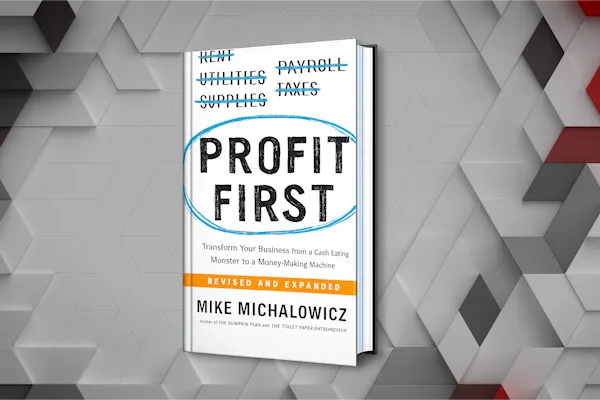
Profit First by Mike Michalowicz Summary: Why Your Business Is Broke
By Vicky Sidler | Published 12 April 2026 at 12:00 GMT+2
There is a terrifying secret hiding inside the accounting department of almost every successful small business: the owner is completely broke.
You probably started your service business to gain financial freedom, but you quickly realized that the more revenue you generate, the more money disappears into an endless black hole of expenses. According to the brilliant Profit First by Mike Michalowicz, this is not a failure of your business model; it is a total failure of traditional accounting. Standard accounting principles are logically sound, but they are behaviorally disastrous for human beings.
We are hardwired to prioritize the first information we see. When you look at a traditional Profit & Loss statement, "Sales" is at the top, and "Profit" is buried at the very bottom. Your brain subconsciously treats profit as a complete afterthought—a leftover scrap you simply hope will exist at the end of the year. This mindset turns your business into a "Cash-Eating Monster" that consumes every dollar of revenue while leaving you stressed and underpaid.
Before you try to solve your cash flow problems by simply selling more, we need to look at exactly why the traditional math is destroying your bank account, and how to reverse the formula.
TL;DR:
Traditional accounting (Sales - Expenses = Profit) guarantees you will always be broke because Parkinson’s Law dictates that your expenses will always expand to consume all available cash.
Profit First reverses the formula (Sales - Profit = Expenses), forcing you to extract your profit immediately and run your business strictly on whatever cash is left over.
By setting up multiple, highly restricted bank accounts, you leverage human psychology to enforce discipline, transforming your business from a cash-eating monster into a money-making machine.
👉 If your business is burning cash on useless software and bloated overhead, your marketing strategy is probably doing the exact same thing. Stop throwing money at massive, generic ad campaigns that don't convert. Download the 5-Minute Marketing Fix to identify exactly where your messaging is failing, so you can start attracting highly profitable clients without increasing your ad spend.
Table of Contents:
Profit First by Mike Michalowicz Summary: Why Your Business Is Broke
Why Will "Selling More" Actually Bankrupt You?
How Do You Actually Hack Your Own Psychology?
What Are The Five Foundational Accounts?
What Is "Real Revenue" And Why Does It Matter?
1. Traction by Gino Wickman Summary: Why Your Service Business Has Stopped Growing
2. The Pumpkin Plan by Mike Michalowicz Summary: Why Hard Work Is Killing Your Business
3. The AI Doom Loop: Why Massive Corporate Layoffs Are Actually Great For You
4. Positioning by Al Ries and Jack Trout Summary: Why Better Never Wins
5. Why Big Tech Ignores Billion Dollar Fines While Your Small Business Cannot
1. What is the core philosophy of Profit First?
2. What is Parkinson’s Law and how does it affect my business?
3. What are the five foundational bank accounts needed for Profit First?
Why Will "Selling More" Actually Bankrupt You?
If you are currently trapped in a cash flow crisis, your accountant has probably told you that the only way out is to increase your revenue.
This is the ultimate GAAP Lie (Generally Accepted Accounting Principles). The standard formula (Sales – Expenses = Profit) suggests that if you simply sell more, you will eventually become profitable. In reality, the exact opposite is true because of a terrifying psychological reality called Parkinson’s Law. This law dictates that our demand for a resource will always expand to meet the supply of it. If you have $20,000 sitting in a single, massive operating account, your brain will magically find a way to spend exactly $20,000.
If you increase your sales to $50,000, you will just find $50,000 worth of new problems to spend it on.
To fix this, Michalowicz insists you must adopt the "Small Plates" approach. If you want to lose weight, you don't use massive dinner plates; you use small plates to artificially restrict your portions. You have to do the exact same thing with your money. By intentionally restricting the "supply" of cash available for expenses, you force your business to innovate. When the money simply isn't there, you stop spending on "nice-to-have" software or redundant overhead because scarcity demands immediate resourcefulness.
But you cannot achieve this scarcity through sheer willpower.
How Do You Actually Hack Your Own Psychology?
If you rely entirely on self-discipline to not spend the money sitting in your checking account, you have already lost the game.
Most entrepreneurs rely on "Bank Balance Accounting." You log into your app, look at the single massive balance in your checking account, and make your spending decisions based entirely on that number. Traditional accounting tries to break this habit by begging you to study complex, incredibly boring P&L statements. Profit First does the exact opposite: it leans directly into your existing bad habits.
If you are going to look at your bank balance anyway, you need to set up multiple, highly specific bank balances that tell you exactly what you are allowed to spend.
What Are The Five Foundational Accounts?
You must physically separate your cash into five specific checking accounts to enforce discipline:
Income: The "serving tray." All revenue goes here, but no bills are ever paid from here.
Profit: Your ultimate reward account. This is strictly off-limits for daily operations.
Owner’s Pay: The fund dedicated entirely to your salary as an employee of your business.
Tax: A reserve for all government liabilities, so you never panic in April.
Operating Expenses (OpEx): The "Small Plate." This is what actually remains to run the day-to-day business.
If you are VAT or Sales Tax registered, you must perform a "Step 0" deduction first. That money is never yours; you are just a collection agent for the government. Move it immediately.
But having five accounts at the same bank is still too dangerous. To truly stop yourself from "raiding the cookie jar" to cover a fake business emergency, you must use a Two-Bank Strategy. You open two "No-Temptation" Hold Accounts (for Profit and Tax) at a completely different, highly inconvenient financial institution. You transfer the money there twice a month, removing it from your daily sight so it is entirely "out of sight, out of mind."
So how do you figure out exactly how much money to put in each bucket?
What Is "Real Revenue" And Why Does It Matter?
If your service business relies heavily on subcontractors or expensive materials, treating every dollar of income as "yours" will cause a massive cash-flow crash.
These are "pass-through" costs. To find your true financial baseline, you must calculate your Real Revenue (Total Income minus Materials & Subcontractors). If you run a $100,000 project but $55,000 goes to subcontractors, your Real Revenue is only $45,000. If you try to take your owner's pay based on the full $100,000, you will immediately go bankrupt because you are paying yourself with money that belongs to your vendors.
Once you know your Real Revenue, you can slowly implement your Target Allocation Percentages (TAPS).
Do not try to change everything overnight, or you will shock your system. Start with the 1% Rule. Tomorrow, take just 1% of your income and move it to your Profit account, deducting that 1% directly from your Operating Expenses. If your business can survive on 100% of its current budget, it can absolutely survive on 99%.
When your OpEx account inevitably runs low, you have reached the "Moment of Reckoning." You are not allowed to raid your Profit or Tax accounts. You must innovate your way out of the crisis by cutting unnecessary subscriptions, firing expensive, low-margin clients, and finally running the lean, highly profitable machine you actually set out to build.
If you are ready to cut the bloated overhead out of your business, you need to cut the bloated corporate jargon out of your marketing. Get my 5-Minute Marketing Fix. It helps you identify exactly where your funnels are leaking highly profitable clients, allowing you to streamline your message and close more sales without spending another dime on advertising.
👉 Stop losing sales. Download the fix now.
Related Articles:
1. Traction by Gino Wickman Summary: Why Your Service Business Has Stopped Growing
Profit First fixes your bank accounts, but Traction fixes your entire operational structure. This summary perfectly complements Michalowicz's financial framework by showing you exactly how to build the leadership team, meeting pulse, and accountability chart required to sustain a highly profitable business.
2. The Pumpkin Plan by Mike Michalowicz Summary: Why Hard Work Is Killing Your Business
When your Operating Expenses account runs dry in Profit First, you have to cut costs. The Pumpkin Plan tells you exactly where to start: by ruthlessly firing your most expensive, highest-maintenance nightmare clients so you can focus all your energy on your most profitable niche.
3. The AI Doom Loop: Why Massive Corporate Layoffs Are Actually Great For You
If you want to see what happens when a company ignores the Profit First philosophy of running lean, look at the tech giants. This article explains the catastrophic "Doom Loop" where massive corporations are currently setting billions of dollars on fire chasing AI, proving exactly why bloated budgets destroy businesses.
4. Positioning by Al Ries and Jack Trout Summary: Why Better Never Wins
To maximize your Real Revenue, you have to charge premium prices. You cannot do that if you look like a generic commodity. This legendary marketing summary explains why you must find a highly specific, defensible position in your prospect's mind so you can command the margins your business needs to survive.
5. Why Big Tech Ignores Billion Dollar Fines While Your Small Business Cannot
Small businesses must obsess over their Tax and Profit accounts because they cannot afford a single misstep. This piece exposes how tech monopolies operate under a completely different set of financial rules, treating massive legal fines as basic overhead, and why you must play a smarter, leaner game to survive.
FAQs:
1. What is the core philosophy of Profit First?
Traditional accounting uses the formula Sales - Expenses = Profit, which makes profit an afterthought. Profit First reverses the formula to Sales - Profit = Expenses. By deducting your profit immediately, you force your business to operate strictly on the remaining cash, virtually guaranteeing profitability.
2. What is Parkinson’s Law and how does it affect my business?
Parkinson’s Law states that our demand for a resource will always expand to meet the supply of it. If you keep all your revenue in a single bank account, you will subconsciously find a way to spend all of it. Profit First uses multiple accounts to artificially restrict your cash supply, forcing innovation and reducing bloated expenses.
3. What are the five foundational bank accounts needed for Profit First?
To physically separate your money and enforce discipline, you need five checking accounts: Income (where all money lands), Profit (your reward), Owner’s Pay (your salary), Tax (government liabilities), and Operating Expenses (the cash left over to actually run the business).
4. What is the Two-Bank Strategy?
Having your Profit and Tax accounts visible in your primary banking app makes it too tempting to "raid" them during a cash-flow crunch. The Two-Bank Strategy requires you to move those specific funds to a completely separate, highly inconvenient bank to ensure the money is truly "out of sight, out of mind."
5. What is Real Revenue for a service business?
If your business relies heavily on subcontractors or expensive materials, treating all income as your own will cause a cash crash. Real Revenue is your Total Income minus those "pass-through" costs. You must base all of your Profit First allocation percentages strictly on your Real Revenue to ensure survival.


Strategic Marketing Tribe helps established service businesses turn underperforming marketing into more predictable growth with the Failure-Proof Marketing System.






Created with clarity (and coffee)