

STORY, MEET STRATEGY
Let’s make marketing feel less robotic and more real.
Find resources that bring your message—and your business—to life.
AI Content Is the New Default Says Ahrefs Study
By Vicky Sidler | Published 13 December 2025 at 12:00 GMT+2
If you’ve read something on the internet lately and thought, “Did a human actually write this?” you’re not alone. Turns out, your gut was probably right. A new study from Ahrefs reveals that nearly three-quarters of new web pages in April 2025 included AI-generated content.
That’s not a typo. Seventy-four percent. More than double the amount of human-only content.
This comes from a large-scale analysis of 900,000 new web pages using Ahrefs’ in-house AI detector (currently named bot_or_not, which feels both charming and slightly terrifying). The goal? To see how much content out there is really written by humans... or at least, started by them.
So what does this mean for your business? Let’s break it down.
TL;DR:
74% of new web pages in April 2025 contain some level of AI-generated content
Only 25% were fully written by humans
Blog posts are the most AI-generated type of content
AI content is becoming the norm due to speed, cost, and built-in tools
No AI detector is perfect, but they’re getting better
Understanding how AI content behaves can help you compete smarter
👉 Need help getting your message right? Download the 5-Minute Marketing Fix
Table of Contents:
AI Content Is the New Default Says Ahrefs Study
Humans Just Lost Majority Control of the Internet:
Why AI Is Now the Default for Content:
Can You Trust AI Content Detectors?
What Can You Actually Do With This Info?
The Secret Sauce Is Still You:
1. Why You Can’t Trust ChatGPT, Perplexity or Other AI For Legal Advice
2. AI Slop Is Breaking the Internet—Here’s What Small Brands Can Do
3. AI Business Advice: Why It Helps Some Owners but Hurts Others
4. AI Skills Gap Explained—Why Some Tools Improve Fast
5. AI Ethics Explained for Small Business Owners
Frequently Asked Questions About AI Content and Detection
1. How much online content is actually written by AI now?
2. Can AI-generated content still rank on Google?
4. Why did my human-written article get flagged as AI?
5. Should I worry if someone says my content is “too AI”?
6. Does using AI to help with writing count as “cheating”?
7. What’s the best way for small businesses to compete with AI content?
8. How can I tell if my competitors are using AI content?
Humans Just Lost Majority Control of the Internet:
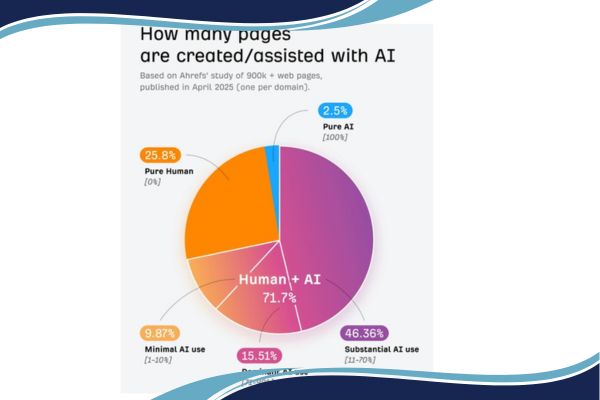
Ahrefs’ team looked at 900,000 pages, each from a different domain. Their AI detector split the pages into three categories:
Pure AI: 2.5%
Pure Human: 25.8%
Mixed AI and Human: 71.7%
Even among the mixed pages, many leaned heavily on AI. Over 35% had more than 40% of the content flagged as AI-generated. That means even when humans are still involved, they are often editing or polishing what a machine wrote first.
Blog posts were the most common use case. Which makes sense. Long-form articles are hard work, and AI can crank out a decent first draft in seconds.
The takeaway? If your competitors are publishing content at lightning speed, it’s probably not because they’re hiring armies of copywriters. They’ve got a little robotic help.
Why AI Is Now the Default for Content:
The big shift isn’t just about what’s possible. It’s about what’s easy. AI writing tools are baked right into Google Docs, Gmail, and LinkedIn. They’re no longer “extra” tools. They’re the tools.
AI now helps you:
Summarise long emails
Draft blog posts
Clean up messy Slack threads
Write captions
Outline articles
And it’s hard to resist. A blinking cursor is intimidating. A “Write for me” button is not.
As more AI-written content goes live, the next layer of content builds on top of it. AI quoting AI quoting AI. It becomes a feedback loop. And before you know it, you're in a world where even your “inspiration” is machine-made.
Can You Trust AI Content Detectors?
Technically, maybe. Realistically, not really.
Here’s the short version of how they work. AI detectors are trained on a mix of known human-written content and known AI-generated content. They look for patterns: sentence structure, predictability, word variation, and more. Then they make an educated guess.
Sometimes a good guess. Sometimes laughably off.
I tested Ahrefs' new free tool recently using content written entirely by me and my human brain. No AI, no prompts, no shortcuts. It flagged the post as 100% AI-generated.
Then it suggested a rewrite.
That rewrite, also tested in the same tool, was returned as 85% AI.
In other words, the detector failed its own test. I don’t know if that’s ironic or just performance art.
To add to the surreal experience, someone in a YouTube comment recently asked if I was AI. So maybe this is how I find out. Which, honestly, still beats waking up in a pod with Morpheus handing me a trench coat and asking if I believe in fate.
The serious point: these tools are still too unreliable to make real decisions with. If you're a teacher, an employer, or a platform considering whether to ban or punish “AI content,” false positives will be your worst nightmare.
Even Ahrefs admits the tool isn’t 100% accurate. And to their credit, they’re right to treat it like any other SEO metric. Helpful in context. Misleading in isolation.
What Can You Actually Do With This Info?
Here’s the practical part.
First, do not panic. AI content is everywhere, but that doesn’t mean you have to publish 12 blogs a week to compete.
What you need is clarity. Most AI content is generic. It doesn’t tell your story. It doesn’t explain your customer’s problem. And it rarely says anything specific about what it’s like to work with you.
That’s where small businesses can win.
Write or commission content that’s:
Focused on your real-life customer conversations
Full of your actual knowledge and experience
Clear, specific, and jargon-free
Easy to scan, honest to read, and human in tone
AI might write the bulk of the internet. But your potential clients are still human. And they can tell when someone is speaking directly to them.
The Secret Sauce Is Still You:
As a Duct Tape Marketing Consultant and StoryBrand Guide, I see the same pattern play out across businesses big and small. When messaging is clear, simple, and based on what customers actually care about, it works. Whether it’s human-written or AI-assisted doesn’t matter as much as clarity.
But clarity doesn’t come from a chatbot. It comes from knowing what you want to say and who you’re saying it to. AI can support that process. It should never lead it.
And if the idea of “content marketing in the age of AI” feels overwhelming, start smaller.
Start with one clear sentence that explains what you do and why it matters. I built a tool for exactly that.
👉 Download the 5-Minute Marketing Fix.
Related Articles:
1. Why You Can’t Trust ChatGPT, Perplexity or Other AI For Legal Advice
If your confidence in AI detection tools is shaken, wait until you see how bad AI is at understanding the law.
2. AI Slop Is Breaking the Internet—Here’s What Small Brands Can Do
This one picks up where the current article ends, showing how AI overload is flooding the internet with false content—and what to do about it.
3. AI Business Advice: Why It Helps Some Owners but Hurts Others
AI doesn’t just get things wrong. Sometimes it gives advice that sounds good but quietly derails your business.
4. AI Skills Gap Explained—Why Some Tools Improve Fast
Ever wondered why some AI tools are better than others? This article explains what’s really happening behind the curtain.
5. AI Ethics Explained for Small Business Owners
If you're using AI tools in your business, this article breaks down the ethics in plain English so you can stay on the right side of trust.
Frequently Asked Questions About AI Content and Detection
1. How much online content is actually written by AI now?
According to a recent Ahrefs study, about 74% of new web pages published in April 2025 included some level of AI-generated content. Only 25% were written purely by humans.
2. Can AI-generated content still rank on Google?
Yes, AI content can rank—especially when it’s useful, clear, and relevant. But Google’s ranking systems still reward quality, originality, and helpfulness, so pure AI fluff is less likely to perform well.
3. Are AI detectors accurate?
Not really. Most detectors work by spotting writing patterns they associate with AI, but they often misfire. Even Ahrefs’ own detector flagged its rewritten output as 85% AI-generated. Use results as a clue, not a verdict.
4. Why did my human-written article get flagged as AI?
AI detectors aren’t judging your creativity. They’re analysing sentence structure, phrasing, and word patterns. If your writing happens to match common AI patterns—even unintentionally—it might still get flagged.
5. Should I worry if someone says my content is “too AI”?
Not unless you’re passing off auto-generated spam as original thought. If your content is clear, useful, and written with care, focus on that. AI detectors can’t measure your intent, expertise, or impact.
6. Does using AI to help with writing count as “cheating”?
Not in business. Using AI for first drafts, outlines, or grammar edits is common. The risk is when you rely on it entirely and skip the human insight that actually connects with customers.
7. What’s the best way for small businesses to compete with AI content?
Focus on what AI can’t do well—your unique perspective, your customer stories, your industry knowledge. Be specific, human, and clear.
8. How can I tell if my competitors are using AI content?
Ahrefs’ new AI content detection tool lets you estimate how much AI content appears on their pages. But again, the results aren’t perfect. Combine this info with a good look at tone and quality.
9. Should I stop using AI for content?
No, but use it smartly. Treat it like a helper, not a strategist. Let it speed up the boring parts, but keep your voice, judgment, and clarity front and center.
10. Where can I start if I need help writing clear content?
Start with one clear sentence.Download the 5-Minute Marketing Fix to get a free guide and AI prompt that helps you explain what you do—simply and powerfully.


Is your Marketing Message so confusing even your own mom doesn’t get it? Let's clarify your message—so everyone wants to work with you!






Created with clarity (and coffee)