
Real news, real insights – for small businesses who want to understand what’s happening and why it matters.
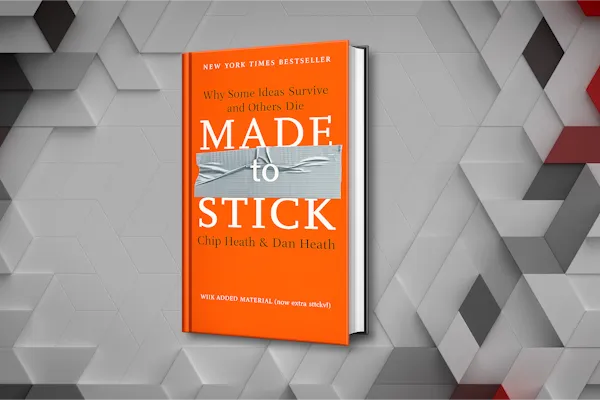
Why Your Expertise Is Actually Killing Your Service Business—Made To Stick By Chip and Dan Heath Summary
By Vicky Sidler | Published 15 March 2026 at 12:00 GMT+2
Have you ever spent twenty minutes passionately explaining a brilliant strategy to a potential client, only to watch their eyes slowly glaze over like a stunned mullet?
You are not alone. As an expert in your field, you probably assume that the biggest barrier to winning new business is your marketing budget or your sneaky competitors. But according to the principles outlined in Made to Stick by Chip and Dan Heath, the real villain is actually your own brain.
You are currently suffering from a severe cognitive bias known as the Curse of Knowledge. Once you understand the deep, technical complexities of your job, it becomes physically impossible for you to remember what it was like to be a clueless beginner.
Before you write another highly technical, profoundly boring consulting proposal, we need to talk about why your expertise is quietly ruining your sales.
TL;DR:
Service providers suffer from the Curse of Knowledge, mistakenly believing that their complex ideas are easy for clients to understand.
To get clients to actually pay attention, you must ruthlessly prune your technical nuance and simplify your message.
You have to stop selling abstract corporate solutions and start using concrete stories that appeal to your client's actual identity.
👉 If your potential clients are already hyper-paranoid, they are looking for any excuse to hit "delete" and assume you are just another automated scam. Identify the exact spots where your message is failing by downloading the 5-minute marketing fix.
Table of Contents:
Why Your Expertise Is Actually Killing Your Service Business—Made To Stick By Chip and Dan Heath Summary
Why Do Your Clients Keep Missing The Point?
Are You Fascinating Or Just Exhausting?
How To Beat The Curse Of Knowledge:
How Do You Break Their Guessing Machine?
Why Abstract Corporate Jargon Is Killing Your Sales:
How Do You Get Out Of Maslow's Basement?
1. Ideal Client Profile: The Marketing Shortcut Small Businesses Miss
2. Content Marketing Strategy Framework Every Small Biz Needs
3. AI Search Is Replacing Google Traffic Faster Than You Think
4. AI SEO Is a Scam for Local Service Businesses
5. How Small Businesses Can Use Hub Pages
1. What is the Curse of Knowledge?
2. What was the Tappers and Listeners experiment?
3. What is a Commander's Intent?
Why Do Your Clients Keep Missing The Point?
To understand why your marketing is failing, we have to look at a famous Stanford psychology experiment.
The researchers divided people into two groups: Tappers and Listeners. The Tappers were asked to tap out the rhythm of a well-known song on a table, and the Listeners had to guess the tune. Because the Tappers could hear the full, beautiful orchestration playing in their own heads, they confidently predicted that half the people would guess the song correctly.
In reality, the Listeners only guessed the song 2.5% of the time. Why? Because they could not hear the music in the Tapper's head. All they heard were a bunch of disconnected, annoying thuds.
As a service provider, you are the Tapper.
Are You Fascinating Or Just Exhausting?
When you talk about your business, you hear the beautiful, complex melody of your expertise.
Your customer just hears a series of disconnected, confusing taps. You suffer from Fluency Misattribution: the incredibly arrogant belief that because an idea makes perfect sense to you, it must be naturally easy for your client to understand.
You desperately want to share every single technical detail because experts are fascinated by complexity. But your clients are not experts. They are novices, and novices are completely paralyzed by complexity.
So how do you stop tapping and start actually communicating?
How To Beat The Curse Of Knowledge:
To fix this, you have to find your Commander's Intent.
The military knows that no complex plan ever survives contact with the enemy, so they use a simple, core objective—like "Take the bridge"—so everyone knows exactly what to do when things go wrong. Southwest Airlines did this by brutally simplifying their entire brand into one phrase: "THE low-fare airline".
If an employee suggests adding a fancy chicken Caesar salad to the menu, the answer is no, because it does not serve the core objective. You must become a master of exclusion, stripping away your beloved technical nuances until only the absolute core of your value remains.
How Do You Break Their Guessing Machine?
But having a simple message is completely useless if the client is ignoring you.
Human brains are literally designed to ignore predictable patterns. If you start a meeting by saying exactly what every other consultant says, their brain shuts off. You have to violate their expectations and open a curiosity gap.
You must figure out what the unexpected implications of your service are, and communicate them in a way that completely subverts their common sense. If the client feels they already know your solution, they have absolutely zero reason to hire you.
But getting their attention is only half the battle. How do you make them actually believe you?
Why Abstract Corporate Jargon Is Killing Your Sales:
When you use "Expert Abstractions" to describe your services, you leave absolutely no hooks in the customer's memory.
You have to use Concreteness, which acts like the Velcro of the mind. The Nature Conservancy figured this out when they stopped trying to sell abstract "acres" of land and started naming specific "Landscape Celebrities" like the Mount Hamilton Wilderness. It is infinitely easier to fund a specific mountain than a generic, boring set of hills.
You have to stop selling abstract "solutions" and start selling concrete deliverables that reduce your client's anxiety.
How Do You Get Out Of Maslow's Basement?
If you want people to actually take action, you have to bypass their Analytical Hat.
Once a client starts calculating numbers, they completely stop feeling. We constantly assume that our customers only care about the bottom of Maslow's Hierarchy, like money and basic security. But the famous "Don't Mess with Texas" campaign succeeded because they did not talk about the environment. They appealed to the macho identity of Texas truck drivers, making littering a personal insult to their home state.
You don't just sell the best seed; you sell the neighbor's envy.
If your marketing is currently a confusing symphony of technical jargon that only you can hear, you are actively driving your clients away. Your expertise is your greatest asset, but your inability to "unknow" it is your greatest liability.
If your website copy is putting people to sleep or failing to convert, do not ask a chatbot to fix it. Get my 5-minute marketing fix. It helps you strip out the boring industry jargon, highlight your actual human value, and figure out exactly what is quietly costing you sales.
👉 Stop losing sales. Download the fix now.
Related Articles:
1. Ideal Client Profile: The Marketing Shortcut Small Businesses Miss
Now that you know your complex explanations are actively driving people away, you need to figure out who you should actually be simplifying things for. This guide shows you how to build a concrete client profile so you can finally stop speaking in vague abstractions and start targeting the exact fears of your best-fit customers.
2. Content Marketing Strategy Framework Every Small Biz Needs
Once you grasp the concept of a simple core message, you need an actual system to stop yourself from over-explaining everything. This framework bridges the gap between stopping your jargon habit and building a practical content system that actually stays focused on the client.
3. AI Search Is Replacing Google Traffic Faster Than You Think
The Curse of Knowledge does not just ruin your human interactions; it is currently destroying your search engine rankings, too. Discover why jargon-filled corporate copy is getting completely ignored by AI search models, and how to structure your newly simplified message so it actually gets found.
4. AI SEO Is a Scam for Local Service Businesses
After realizing that complex expertise is not what actually sells, your panicked expert brain will probably try to fix the problem by buying complicated SEO tools. Read this post to find out why fancy AI-driven SEO is a total myth for local service businesses, and why straightforward messaging is your only real defense.
5. How Small Businesses Can Use Hub Pages
You finally have a single, simple core idea, but now you have to logically organize it before you completely overwhelm your website visitors again. This piece shows you how to build a structured hub-and-spoke content system so potential clients instantly understand what you do without getting lost in your scattered expertise.
FAQs:
1. What is the Curse of Knowledge?
The Curse of Knowledge is a cognitive bias where an expert finds it nearly impossible to imagine what it is like not to know something. Because the information is easy for the expert to process, they mistakenly assume it is naturally easy for their clients to understand.
2. What was the Tappers and Listeners experiment?
It was a Stanford study where "Tappers" knocked out the rhythm of a song on a table and "Listeners" tried to guess it. Tappers predicted a 50% success rate because they heard the song in their heads, but Listeners, who only heard disconnected thuds, only guessed correctly 2.5% of the time.
3. What is a Commander's Intent?
A Commander's Intent is a military concept used to manage the fog of war by providing a simple, core objective, like "Take the bridge". In business, it means stripping an idea down to its critical essence so it can guide employee behavior without constant oversight.
4. How do you break a client's "guessing machine"?
Human brains ignore predictable patterns, so you must violate their expectations. You break their guessing machine by communicating your core message in a way that subverts "common sense," opening a curiosity gap that they feel an intellectual need to close.
5. Why should I use concrete language in my marketing?
Concrete language acts as the "Velcro" of the mind, providing sensory information that is easy to remember. Service businesses often fail by speaking in "Expert Abstractions" that leave no hooks in the customer's memory, whereas concrete deliverables reduce client anxiety.


Strategic Marketing Tribe helps established service businesses turn underperforming marketing into more predictable growth with the Failure-Proof Marketing System.





Created with clarity (and coffee)