Real news, real insights – for small businesses who want to understand what’s happening and why it matters.
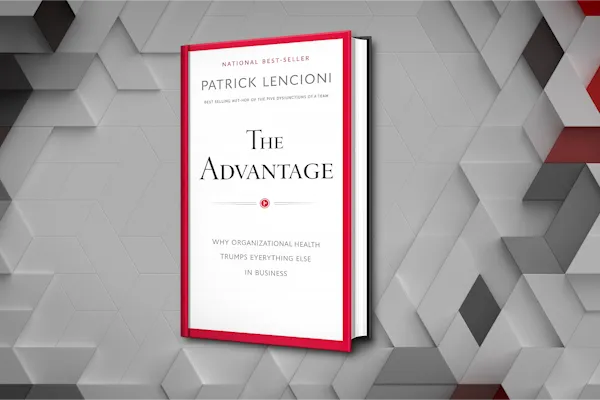
The Advantage by Patrick Lencioni Summary: Why "Smart" Businesses Still Fail
By Vicky Sidler | Published 19 April 2026 at 12:00 GMT+2
There is a terrifying delusion plaguing the founders of almost every small-to-medium service business on the planet: the belief that if you are just a little bit "smarter" than your competitors, you will automatically win.
You pour all of your resources into the "smart" side of the house. You obsess over complex marketing funnels, cutting-edge technology, and aggressive financial strategies. But according to the brutal reality outlined in The Advantage by Patrick Lencioni summary, being "smart" is no longer a strategic advantage; it is a cheap, easily duplicated commodity. In an era where everyone has access to the exact same information and software, being smart is merely the minimum standard required just to enter the arena. It gives you permission to play, but it does not give you permission to win.
The true, uncopyable strategic moat for a small business looking to outmaneuver a corporate giant isn't intelligence; it is Organizational Health. Most companies exploit only a tiny fraction of their intellectual capital because the rest is hopelessly trapped behind toxic internal politics, massive confusion, and bureaucratic friction. Before you spend another dollar upgrading your software, we need to look at exactly why your brilliant strategies are failing, and how to fix the broken human foundation underneath them.
TL;DR:
Being "smart" (having good strategy, finance, and tech) is a commodity. It is merely the price of admission to the modern business arena.
Organizational Health is the ultimate multiplier. A healthy company minimizes politics and confusion, allowing it to tap into 100% of its intellectual capital.
You cannot build a healthy company without a behaviorally cohesive leadership team that engages in passionate, productive conflict and demands peer-to-peer accountability.
👉 If your internal team is confused about your strategy, your customers are definitely confused by your marketing. You cannot scale chaos. Download the 5-Minute Marketing Fix to align your entire organization around a single, undeniable message, so you can stop losing highly profitable clients to competitors with inferior services.
Table of Contents:
The Advantage by Patrick Lencioni Summary: Why "Smart" Businesses Still Fail
Why Is Your Team Sabotaging Your Brilliant Strategy?
Are You Suffering From The "Consensus Trap"?
Why Are Your Employees Ignoring Your Emails?
How Do You Weaponize Your Hiring Process?
1. Traction by Gino Wickman Summary: Why Your Service Business Has Stopped Growing
2. Profit First by Mike Michalowicz Summary: Why Your Business Is Broke
3. The Pumpkin Plan by Mike Michalowicz Summary: Why Hard Work Is Killing Your Business
4. Why Asking ChatGPT For Business Strategy Will Bankrupt You
5. Positioning by Al Ries and Jack Trout Summary: Why Better Never Wins
1. What is the main thesis of The Advantage?
2. What are the Five Behaviors of a Cohesive Team?
3. What does Lencioni mean by "Artificial Harmony"?
Why Is Your Team Sabotaging Your Brilliant Strategy?
You can have the most sophisticated, data-driven strategy in your industry, but if your leadership team is fractured, that strategy will die the second it leaves the boardroom.
In a small service business, any tiny crack in the leadership team is violently magnified as it trickles down to the front lines. It results in wildly inconsistent client service and massive employee disengagement. Lencioni argues that behavioral cohesion at the top is the non-negotiable foundation of growth. To achieve this, your leadership team must master the "Five Behaviors."
It all starts with vulnerability-based trust—leaders must be willing to admit their mistakes and weaknesses without fear of punishment. Without this trust, teams fall into "Artificial Harmony," smiling in meetings while secretly undermining each other in the hallways. A healthy team actively seeks out passionate, ideological conflict to find the best possible solution, fully embracing the philosophy to "Disagree and Commit."
But even if your team learns how to argue productively, they still need to know exactly what they are arguing about.
Are You Suffering From The "Consensus Trap"?
Most businesses are paralyzed because their leaders mistake "compromise" for "clarity."
Once a team is behaviorally cohesive, they must achieve total intellectual alignment. Clarity is not some soft, feel-good HR concept; it is a rigid, functional requirement that ensures there is absolutely no "daylight" between leaders regarding the organization’s direction. Lencioni insists that the leadership team must be able to unanimously answer six critical questions, including "Why do we exist?", "How do we behave?", and "What is the single most important thematic goal for the next 3-12 months?"
If your executives cannot agree on the exact same answers to those questions, your employees are receiving deeply conflicting instructions every single day.
You must define your exact Core Values. And you cannot use "Permission-to-Play" values like honesty or integrity. Your core values must be the brutal, authentic differentiator that makes your organization actively intolerant of anyone who does not fit the culture. Once you define those rules, you have to ensure the rest of the company actually believes them.
Why Are Your Employees Ignoring Your Emails?
Clarity is completely useless if it remains securely locked inside the executive suite.
Most leaders announce a new strategic direction once at an annual kickoff meeting, and then act completely shocked when nobody remembers it three weeks later. Lencioni argues that leaders must master "Spaced Repetition." This is the architectural principle stating that a message must be clearly communicated at least seven times before it is truly believed and internalized by the staff.
You cannot rely on a single, boring email. You have to "Over-communicate Clarity" by intentionally cascading information down the org chart. At the end of every single executive meeting, the team must agree on exactly what was decided, who is going to communicate it, and how they will deliver the message in person. You have to actively seed the organizational rumor mill with "true rumors," ensuring the correct information reaches the staff before toxic speculation and office politics can fill the vacuum.
But talk is cheap. To make organizational health permanent, you have to build it directly into your human systems.
How Do You Weaponize Your Hiring Process?
For organizational health to survive the brutal whirlwind of daily operations, it must be embedded into the very fabric of how you hire, fire, and reward your people.
Every single human system must ruthlessly protect the culture. When interviewing candidates, Lencioni’s framework demands you screen for the "Ideal Team Player" by looking for three specific virtues: Humble, Hungry, and Smarts (Emotional Intelligence). You cannot just ask generic questions. You have to look for immediate red flags.
If you ask a candidate for their biggest weakness, and they pivot to a "strength-disguised-as-a-weakness" (like "I just work too hard"), they lack the necessary humility for vulnerability-based trust. If you ask what annoys them about their coworkers, and they use the opportunity to aggressively trash their former team, they lack the emotional intelligence required to survive in a healthy environment.
Intelligence is just a commodity. Organizational health is the ultimate multiplier that allows your smart assets to actually perform. If your business feels like a chaotic, cash-eating monster, it is because your foundation is cracked. You need a fast, effective way to align your team and your messaging. Get my 5-Minute Marketing Fix. It is a rapid diagnostic tool that helps you strip out the confusing corporate jargon so you can build a clear, uncopyable competitive advantage that actually drives revenue.
👉 Stop losing sales. Download the fix now.
Related Articles:
1. Traction by Gino Wickman Summary: Why Your Service Business Has Stopped Growing
If The Advantage explains why you need organizational health, Traction explains exactly how to build the operational machine to support it. This summary provides the practical framework (EOS) required to organize your leadership team, set clear metrics, and actually execute Lencioni’s vision.
2. Profit First by Mike Michalowicz Summary: Why Your Business Is Broke
A healthy organization cannot survive if it is constantly stressed about making payroll. This financial summary perfectly complements Lencioni’s behavioral model by showing you how to artificially restrict your expenses and force your business to be permanently profitable from day one.
3. The Pumpkin Plan by Mike Michalowicz Summary: Why Hard Work Is Killing Your Business
Just as Lencioni demands you filter out toxic employees using Core Values, Michalowicz demands you filter out toxic clients. This summary explains how to ruthlessly fire the high-maintenance nightmare clients that are actively destroying your team's morale and draining your intellectual capital.
4. Why Asking ChatGPT For Business Strategy Will Bankrupt You
If your leadership team lacks the behavioral cohesion to make hard strategic decisions, you might be tempted to just ask an AI to do the thinking for you. This Harvard study proves exactly why outsourcing your business strategy to a chatbot results in generic "trendslop" that guarantees failure.
5. Positioning by Al Ries and Jack Trout Summary: Why Better Never Wins
Lencioni insists your Core Values must be a genuine differentiator, not just "permission to play." This legendary marketing summary explains the psychological mechanics behind differentiation, proving why you must own a highly specific, defensible position in your prospect's mind to win the market.
FAQs:
1. What is the main thesis of The Advantage?
Patrick Lencioni argues that being "smart" (having good strategy, finance, and marketing) is merely a commodity required to enter the market. The ultimate, uncopyable competitive advantage is "Organizational Health"—a state where management, operations, and culture are completely unified and free of toxic politics.
2. What are the Five Behaviors of a Cohesive Team?
To build a healthy organization, the leadership team must master five behaviors: Vulnerability-Based Trust, Productive Conflict (avoiding artificial harmony), Active Commitment (disagree and commit), Peer-to-Peer Accountability, and a focus on Collective Results over personal egos.
3. What does Lencioni mean by "Artificial Harmony"?
Artificial Harmony occurs when a leadership team lacks trust and avoids necessary, passionate debate. Instead of arguing to find the best strategic solution, team members smile politely in meetings to avoid tension, but silently disagree and undermine the decisions later in private.
4. How do you create Intellectual Clarity in a business?
The leadership team must be able to unanimously answer six critical questions without any daylight between them: Why do we exist? How do we behave? What do we do? How will we succeed? What is most important right now? and Who must do what?
5. What are the three virtues of an Ideal Team Player?
To embed organizational health into your hiring process, you must screen every candidate for three specific virtues: Humble (willing to admit mistakes), Hungry (self-motivated and hard-working), and Smarts (possessing the emotional intelligence and common sense required to work well with others).

Strategic Marketing Tribe helps established service businesses turn underperforming marketing into more predictable growth with the Failure-Proof Marketing System.



Created with clarity (and coffee)