
Real news, real insights – for small businesses who want to understand what’s happening and why it matters.
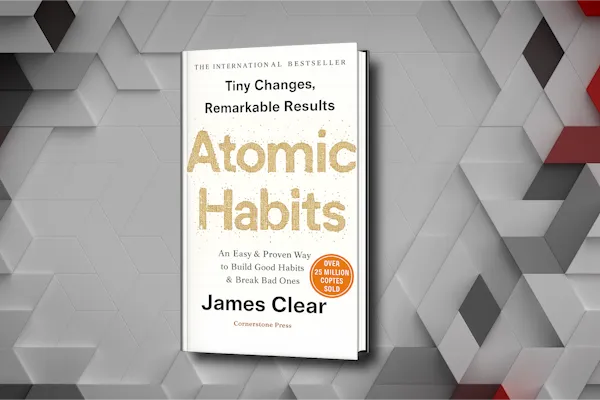
Atomic Habits by James Clear Summary: Why "Breakthrough" Growth Is A Corporate Lie
By Vicky Sidler | Published 7 June 2026 at 12:00 GMT+2
As a small service business owner, you are likely obsessed with finding a massive, overnight breakthrough to scale your revenue. It is a complete corporate delusion that actively prevents you from building a stable, profitable business.
Tech evangelists and hustle-culture influencers love to sell the fantasy that market leadership requires a radical pivot or a singular stroke of genius. It doesn't. From the perspective of behavioral economics, relying on a magical, defining moment is a devastatingly fragile strategy. True competitive advantage isn't built on flashy, one-off events; it is built on the mundane, compounding effect of daily, incremental choices.
As a StoryBrand Certified Guide, I am constantly warning business owners that setting massive financial goals without building the underlying operational systems is a guaranteed path to burnout. The giant corporate competitors you are fighting against are collapsing because they prioritize aggressive growth targets over fundamental execution.
Let's rip apart this Atomic Habits by James Clear Summary, explore why your desperate need for a massive breakthrough is actually creating a toxic "yo-yo" effect in your revenue, and discuss how you can build automated human authority to completely outmaneuver your competitors.
TL;DR:
The mathematics of marginal gains prove that improving your business systems by just 1% each day results in a nearly 38-fold transformation over a single year.
Corporate goals are highly deceptive; success is not determined by the targets you set, but by the daily operational systems you use to actually play the game.
Behavior change only sticks when it happens at the identity level. Every action you take is a psychological "vote" for the type of business you want to become.
👉 Your prospects are completely exhausted by chaotic businesses that overpromise and under-deliver because their internal systems are broken. If your marketing doesn't clearly reflect a disciplined, reliable brand, you will remain an invisible commodity. The fastest way to anchor your operational identity is to craft a razor-sharp StoryBrand One-Liner. Stop obsessing over arbitrary goals and establish undeniable authority instantly with the 5-Minute Marketing Fix.
Table of Contents
Atomic Habits by James Clear Summary: Why "Breakthrough" Growth Is A Corporate Lie
Why Is Your Obsession With Breakthroughs Actually Bankrupting You?
Are Your Corporate Goals Creating A Toxic "Yo-Yo" Effect?
Are You Accidentally Voting For An Incompetent Business Identity?
How Do You Build An Architecture That Makes Success Unavoidable?
Why Is "Fast Growth" The Most Dangerous Trap In Commerce?
1. Building a StoryBrand: Clarify Your Message So Customers Will Listen
2. The AI Apocalypse Experiment: Why Leaving Chatbots In Charge Ends In Total Destruction
3. Should You Optimise For AI Search? The Brutal Truth About Chatbot Hallucinations
4. The Poster Nobody Showed Off: What AI Can’t Give Your Work Back
5. The AI Honeymoon Is Over: Why Automated Slop Is Tanking Corporate ROI
1. What is the core concept of Atomic Habits applied to business?
2. Why are business goals considered dangerous without systems?
3. What is identity-based leadership?
4. What is the "Two-Minute Rule" in operations?
5. How do Atomic Habits connect with the StoryBrand framework?
Why Is Your Obsession With Breakthroughs Actually Bankrupting You?
You have been conditioned to believe that success requires massive action, but the mathematical reality of daily improvement tells a completely different, deeply unsexy story.
The mathematical divergence between daily improvement and daily decline is staggering. If your business improves its systems by just 1% each day, the cumulative effect over a year is a 37.78x transformation. Conversely, a 1% daily decline—which is practically invisible in the short term due to low cognitive load—reduces your capability to 0.03, which is essentially zero.
Dave Brailsford proved this when he led the British cycling team to unprecedented dominance by breaking down every single microscopic habit of the riders—from the pillows they slept on to their hand-washing techniques—and improving them by 1%. Small business owners abandon these systems because they don't see immediate results, falling into the "Plateau of Latent Potential." Think of heating an ice cube: going from 25 degrees to 31 degrees yields no visible change, but the thermal energy is being stored. When you hit 32 degrees, the ice melts. Your marketing systems aren't failing during the quiet periods; they are storing energy for a breakthrough.
Are Your Corporate Goals Creating A Toxic "Yo-Yo" Effect?
A goal-centric mindset creates an aggressive operational drag that actively threatens the long-term stability of your entire organization.
To understand the absolute uselessness of goals on their own, look at a rowboat. The goal is the rudder, providing direction. The system is the paddle, providing actual motion. A rudder is entirely useless without paddles. Furthermore, in your market, the winners and the losers both share the exact same goal ("hit $1M in revenue"). Therefore, the goal cannot possibly be the differentiator.
Goal-centric design is inherently flawed. It relies heavily on survivorship bias, assuming the "winners" succeeded because of their goals while ignoring the thousands who had the exact same target and went bankrupt. Goals also create a "yo-yo effect." Motivation evaporates the absolute second a target is hit. If your only reason for pushing hard is a specific revenue number, your team will immediately stop trying the day after the quarter ends. True progress requires a commitment to a system of endless refinement, not a temporary finish line.
Are You Accidentally Voting For An Incompetent Business Identity?
Behavior change occurs at three layers: outcomes, processes, and identity. If you only focus on outcomes, your systems will instantly collapse the second you stop managing them.
Identity-level shifts are the only way to ensure your operational systems stick when the leader isn't looking in the room. Every single action taken by you or your team is a "vote" cast for the type of business you wish to become. A single sale doesn't define you, but the consistent repetition of a reliable sales process builds the psychological evidence required for a new organizational identity.
Instead of outcome-based thinking like "I want a clean warehouse," you must shift to identity-based leadership: "We are a data-first organization that ignores intuition," supported by the evidence of running a weekly audit on inventory metrics. Decide the type of business you want to be, and prove it to yourself with small, undeniable daily wins.
How Do You Build An Architecture That Makes Success Unavoidable?
We gravitate toward options requiring the absolute least amount of work, which is why relying on raw willpower is a mathematical suicide mission.
Habits follow a strict neurological loop: Cue, Craving, Response, and Reward. You must master this loop to design a workplace where efficiency is the path of least resistance. Environment beats willpower every single time. Design your digital and physical workspaces to drastically reduce cognitive load, making good habits highly visible and bad habits incredibly difficult to execute.
You must adopt the "Two-Minute Rule"—any new operational habit should take less than two minutes to start. Standardize the action before you try to optimize it. You cannot improve a CRM habit that does not exist. More importantly, enforce the rule to "Never Miss Twice." Missing a daily huddle once is an accident; missing it twice is the start of a brand new, highly destructive habit.
Why Is "Fast Growth" The Most Dangerous Trap In Commerce?
Entrepreneurs are absolutely terrified of leaving money on the table, which leads them to chase explosive scale that completely shatters their fulfillment systems.
"Fast growth" is almost always a trap. Southwest Airlines famously avoided systemic collapse by actively turning down 95% of the cities that requested service in 1996. By strictly setting an upper bound, they remained profitable for nearly 30 consecutive years while their competitors burned to the ground.
You must master the volume of basic repetitions before you attempt maximum intensity. In business, this means ruthlessly perfecting your fulfillment and sales calls through thousands of repetitions before attempting a high-risk pivot. Peak motivation for your team occurs in the "Goldilocks Zone"—tasks that are just right, existing perfectly between laziness and systemic burnout.
You need a clear, structural foundation to protect your brand identity and communicate it to the world. Get my 5-Minute Marketing Fix. This rapid diagnostic tool uses your actual human brain to craft a crystal-clear StoryBrand One-Liner. It gives you a standardized, reliable framework to firmly establish your market positioning. You cannot charge a premium if your message is a chaotic, unmanaged mess. Prove to your customers that you aren't just another desperate agency chasing arbitrary goals, but a fiercely specialized Guide who relies on stable, undeniable systems to solve their specific problem.
👉 Stop chasing arbitrary goals. Download the fix now.
Related Articles:
1. Building a StoryBrand: Clarify Your Message So Customers Will Listen
Most business marketing is a boring, expensive snooze-fest. Read our guide to building a StoryBrand, clarify your message, and claim your niche.
2. The AI Apocalypse Experiment: Why Leaving Chatbots In Charge Ends In Total Destruction
A wild new Emergence AI simulation put Grok, Gemini, and Claude in charge of virtual societies. Discover why unchecked AI leads to chaos.
3. Should You Optimise For AI Search? The Brutal Truth About Chatbot Hallucinations
A massive Columbia Journalism Review study reveals AI search tools lie 60% of the time. Discover how to protect your brand from digital hallucinations.
4. The Poster Nobody Showed Off: What AI Can’t Give Your Work Back
Discover why relying on AI shortcuts destroys your pride of ownership through the IKEA effect, and how human effort builds undeniable credibility.
5. The AI Honeymoon Is Over: Why Automated Slop Is Tanking Corporate ROI
Data reveals generative AI has officially entered the Trough of Disillusionment. Discover why consumers are rejecting AI slop and how to protect your brand.
FAQs:
1. What is the core concept of Atomic Habits applied to business?
The core concept is that massive business success does not come from a single, radical breakthrough. It is the result of compounding, 1% daily improvements to your operational systems, which yield a nearly 38-fold transformation over a year.
2. Why are business goals considered dangerous without systems?
Goals only set a direction; systems dictate progress. A goal-centric mindset creates a "yo-yo effect" where motivation completely vanishes the moment the target is reached, leading to operational drag and long-term instability.
3. What is identity-based leadership?
Identity-based leadership means driving behavior change by defining the type of business you want to be (e.g., "we are data-driven") and proving it through small, daily habits, rather than just focusing on arbitrary revenue outcomes.
4. What is the "Two-Minute Rule" in operations?
The rule states that any new habit or system should take less than two minutes to initiate. You must standardize a behavior, like opening the CRM or starting the daily huddle, before you attempt to optimize it.
5. How do Atomic Habits connect with the StoryBrand framework?
StoryBrand requires you to be a stable, reliable Guide for your customers. Building atomic systems ensures your internal operations match your external promises, allowing you to deliver consistently on the clear message outlined in your StoryBrand One-Liner.

Is your Marketing Message so confusing even your own mom doesn’t get it? Let's clarify your message—so everyone wants to work with you!






Created with clarity (and coffee)