

Real news, real insights – for small businesses who want to understand what’s happening and why it matters.
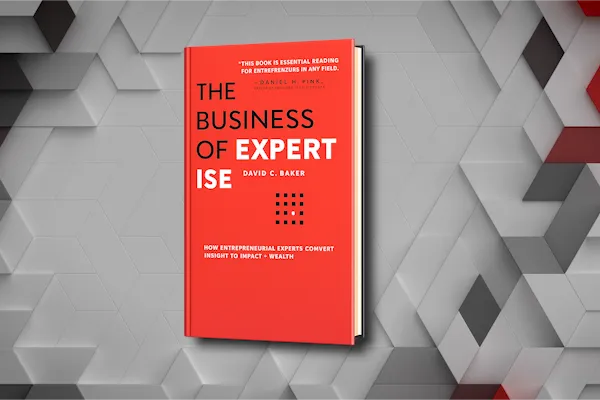
The Business Of Expertise by David C. Baker Summary: Why Being A Generalist Is Bankrupting Your Agency
By Vicky Sidler | Published 31 May 2026 at 12:00 GMT+2
As a small service business owner, you probably pride yourself on your ability to "do it all" for your clients. But I have some terrifying, deeply cynical news for you: your desperate need for variety is exactly why you are broke, exhausted, and completely interchangeable with a cheap AI chatbot.
According to the absolutely ruthless manifesto on agency survival, The Business of Expertise by David C. Baker, most firm owners are just technicians who suffered a massive entrepreneurial seizure. Instead of building a highly lucrative, specialized business, they just built themselves a chaotic, low-paying job. If you blindly say "yes" to every prospect that walks through the door because you are terrified of losing revenue, you are categorically preventing yourself from ever becoming an actual expert.
As a StoryBrand Certified Guide, I am constantly warning business owners that trying to be "everything to everyone" is a guaranteed death sentence in a market currently drowning in automated generative slop. True success is not found by working 80-hour weeks in a frantic panic; it is found at the intersection of deep expertise and ruthless entrepreneurship.
Let's rip apart "The Business Of Expertise by David C. Baker Summary," explore why your desperate fear of boredom is destroying your price premium, and discuss how you can use undeniable human authority to completely obliterate your robotic competitors.
TL;DR:
True expertise is not general intelligence; it is the ability to recognize patterns across similar data sets. If you take on random, wildly different projects, you never encounter the repetition required to actually become an expert.
Capturing a price premium requires a "Two-Room Model." You must aggressively decouple your high-value strategic thinking (The First Room) from your commoditized implementation (The Second Room).
Strong positioning is a process of avoidance. If your marketing doesn't actively repel the wrong prospects, you are just an invisible, highly interchangeable commodity.
👉 Your prospects are completely exhausted by desperate generalists who promise everything but specialize in nothing. If you cannot clearly articulate your exact expertise, you will remain an invisible, underpaid commodity. The fastest way to confidently claim your niche is to craft a razor-sharp StoryBrand One-Liner. Stop blending in and establish undeniable authority instantly with the 5-Minute Marketing Fix.
Table of Contents
The Business Of Expertise by David C. Baker Summary: Why Being A Generalist Is Bankrupting Your Agency
Why Is Your Desperate Need For "Variety" Bankrupting Your Firm?
Are You Selling Your Brain, Or Just Renting Out Your Hands?
Why Does Your Content Marketing Put Prospects To Sleep?
How Do You Engineer A Firm That Someone Actually Wants To Buy?
1. Why The Corporate World Is Secretly Sabotaging Its Own AI Strategy
2. Why A Multi-Billion-Dollar AI Cannot Solve A High School Crossword Puzzle
3. Why The Public Is Literally Revolting Against AI (And How To Cash In)
4. Why Paying $32 Billion For Fake AI Influencers Will Destroy Your Brand
5. Why Disney Just Fired Marvel’s Artists For AI Slop They Can’t Even Legally Own
1. What is the core message of The Business of Expertise by David C. Baker?
2. What is the Two-Room Model?
3. Why does David C. Baker say variety is bad for business?
Why Is Your Desperate Need For "Variety" Bankrupting Your Firm?
Entrepreneurs are absolutely terrified of being bored, and this childish fear is actively destroying their profit margins.
Firm owners suffer from the "Generalist/Specialist Paradox"—they mistakenly believe that narrowing their focus will result in a terrifying lack of work. So, they take on every "special snowflake" project that comes their way. But expertise is fundamentally just pattern matching.
Think of the mathematician John Nash; you have to be able to see through a sea of random variables to identify the underlying structure. But pattern recognition requires multiple similar scenarios to function. If you never repeat the same type of project, you literally never encounter the repetition necessary to develop deep insight. Without a narrow focus, you remain an utterly interchangeable commodity, and interchangeability is the absolute death of profit.
Are You Selling Your Brain, Or Just Renting Out Your Hands?
If your clients are treating you like a cheap, expendable gig worker, it is because you are actively training them to do exactly that.
Capturing a massive price premium requires a strategic, architectural decoupling of "thinking" from "doing," known as the Two-Room Model. The "First Room" is the diagnostic, strategic phase where high-value insight happens. This is where you sell your thoughts and architect the solution, and it is the only room where a price premium exists. The "Second Room" is the execution—the writing, design, or auditing. This work is a highly substitutable commodity. You must never, ever allow a client to buy your implementation without first passing through your strategic diagnosis.
Why Does Your Content Marketing Put Prospects To Sleep?
Most corporate blogs are a desolate wasteland of uninspired garbage because executives are utterly terrified of having an actual opinion.
Most "content marketing" is completely ignorable because it lacks a definitive point of view. Baker argues that "Insight Marketing," on the other hand, is memorable because it is polarizing and aggressively challenges obvious thinking. You do not write because you have a fully formed idea; you write to figure out what you actually think. A successful expert is like a table supported by two heavy legs: Deep Topic Knowledge (like Pricing) and Deep Audience Knowledge (like Credit Unions). If you give away your best, generalized theoretical frameworks for free, you can charge absolute top-tier fees for the specific, private application of those tools to a client's unique dysfunction.
How Do You Engineer A Firm That Someone Actually Wants To Buy?
If your entire business instantly collapses the second you take a two-week vacation to the beach, you do not own a business; you own a horribly stressful trap.
The exact same factors that make a firm highly "sellable" make it wonderful to run on a daily basis. To build objective market value, you must maintain an EBITDA of over 20% after paying yourself a fair market salary. If you underpay yourself, you aren't profitable; you are just subsidizing the business with your own slave labor. Furthermore, no single client should ever represent more than 25% of your revenue, and you must build a "Number Two" team. If you are the only human being on earth who can solve the client's problem, your firm has exactly zero value to a potential buyer.
You need a clear, structural foundation to protect your brand from unseen automated errors. Get my 5-Minute Marketing Fix. This rapid diagnostic tool uses your actual human brain to craft a crystal-clear StoryBrand One-Liner. It gives you a standardized, reliable framework to establish genuine human connection. You cannot beat a billion-dollar algorithm at its own game, but you can easily beat it with deep, specialized empathy. Prove to your customers that you aren't just another lazy generalist pushing unchecked AI slop, but a fiercely human Guide who actually has a plan to solve their problem.
👉 Stop publishing automated garbage. Download the fix now.
Related Articles:
1. Why The Corporate World Is Secretly Sabotaging Its Own AI Strategy
Executives are forcing AI tools onto their workforce, but employees are secretly rebelling. Discover why corporate AI is failing and how your brand can exploit it.
2. Why A Multi-Billion-Dollar AI Cannot Solve A High School Crossword Puzzle
Discover why advanced AI completely fails at basic crosswords, what "tokenization" means for your business, and why human oversight is your ultimate advantage.
3. Why The Public Is Literally Revolting Against AI (And How To Cash In)
The public backlash against AI has exploded into a literal rebellion. Discover why consumers are rejecting tech billionaires and how your human brand can steal their market share.
4. Why Paying $32 Billion For Fake AI Influencers Will Destroy Your Brand
The influencer market is hitting $32B, and corporate executives are replacing humans with AI avatars. Discover why faking human connection is a massive trap that will bankrupt your brand.
5. Why Disney Just Fired Marvel’s Artists For AI Slop They Can’t Even Legally Own
Disney laid off 1,000 workers, including Marvel's legendary visual team, while partnering with OpenAI. Discover the hilarious legal trap of trading your human creativity for cheap, uncopyrightable content.
FAQs:
1. What is the core message of The Business of Expertise by David C. Baker?
The core message is that service firms must stop being interchangeable generalists. True success and price premiums are achieved through deep, focused expertise, which allows you to recognize patterns and solve complex problems faster than anyone else in your narrow market.
2. What is the Two-Room Model?
The Two-Room Model is a strategic operational framework where you decouple your high-value diagnostic thinking (The First Room) from your commoditized implementation and execution (The Second Room). You must never sell the execution without first selling the strategy.
3. Why does David C. Baker say variety is bad for business?
While entrepreneurs crave variety to avoid boredom, taking on wildly disparate projects prevents you from seeing recurring problems. Without encountering similar scenarios repeatedly, you cannot develop the "pattern matching" skills required to be a true expert.
4. What makes a service firm sellable?
A firm is sellable when it proves it can thrive without the founder. This requires maintaining an EBITDA over 20%, ensuring no single client is more than 25% of total revenue, and having a highly competent "Number Two" team that handles the daily operations.
5. How does expertise relate to the StoryBrand framework?
The StoryBrand framework requires you to position your business as an authoritative Guide. By narrowing your focus and specializing as David C. Baker suggests, you naturally generate the deep empathy and undeniable authority required to guide your specific customers to success.



Strategic Marketing Tribe helps established service businesses turn underperforming marketing into more predictable growth with the Failure-Proof Marketing System.






Created with clarity (and coffee)